
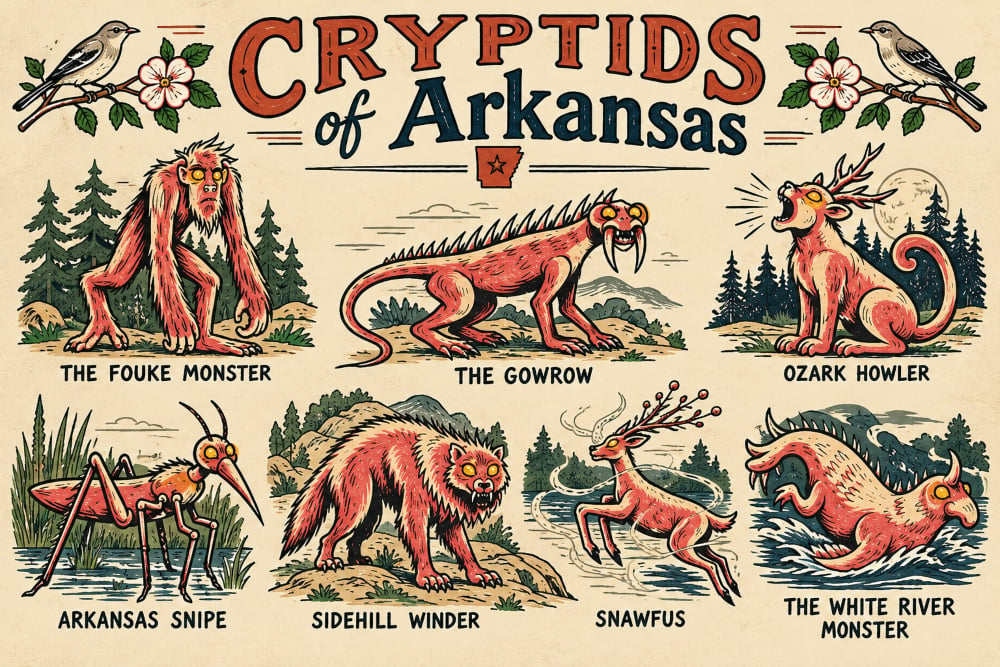

From the Ozark Howler to the Boggy Creek Monster, Arkansas has its share of mysterious creatures. Just because science hasn’t found them doesn’t mean they aren’t watching you from the woods.
Arkansas is known for its incredible outdoor recreation opportunities, from hiking the Ozark Highlands Trail and paddling the Buffalo National River to exploring the swamps of the Delta. But while most outdoor enthusiasts worry about ticks, poison ivy, snakes and the occasional bear, there may be something else lurking in the Natural State.
Something mysterious. Something hairy. Something that probably smells worse than your mountain bike shoes after a muddy ride.
We’re talking about cryptids, creatures whose existence is claimed in folklore and eyewitness accounts but remains unconfirmed by science.
Arkansas has a surprisingly impressive collection of these legendary beasts. Some have terrified generations of residents, others have inspired movies, and at least one has probably been used to embarrass unsuspecting campers.
In celebration of Halloween, Arkansas Outside presents seven of Arkansas’ most notorious cryptids. Whether you’re hiking, camping, paddling or just trying to make it back to the trailhead before dark, keep your eyes open.
And remember, if you see one, take a picture. Preferably something better than the usual blurry photograph of a tree stump.
The Ozark Howler: The Sound of Something You Don’t Want to Meet
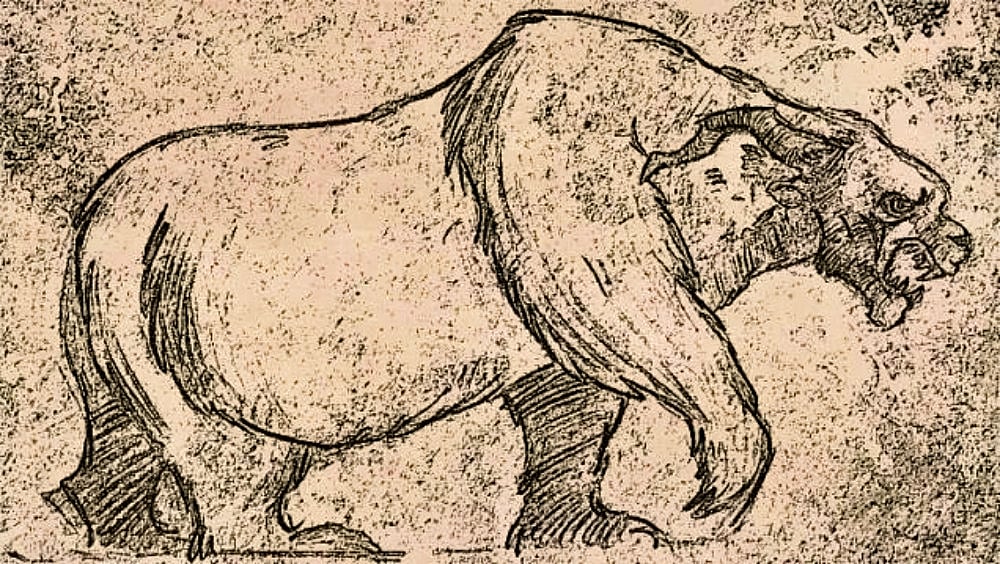
Deep in the Ozark Mountains, where the forest grows thick and the nearest cellphone signal is three ridges away, legend tells of a creature known as the Ozark Howler.
Descriptions vary, but most agree that the beast resembles a large, shaggy black cat or wolf, sometimes sporting horns and glowing red eyes. Its most distinctive feature, however, is its terrifying howl, described as a combination of a wolf, an elk and a person screaming.
In other words, the exact sound you want to hear while camping alone.
Stories of the Howler have circulated throughout the Ozarks, although its origins are difficult to pin down. Some accounts connect the creature to older regional folklore, while others appear to be modern additions to the legend.
Skeptics suggest the mysterious calls could come from ordinary wildlife, including bobcats, coyotes or other animals whose nighttime vocalizations can be surprisingly unsettling.
Of course, that’s exactly what the Howler would want you to believe.
Outdoor survival tip: If you hear a bloodcurdling scream while camping in the Ozarks, remain calm. It’s probably a bobcat. If the bobcat has horns and glowing red eyes, reconsider your campsite selection.
The White River Monster: Arkansas’ Answer to the Loch Ness Monster
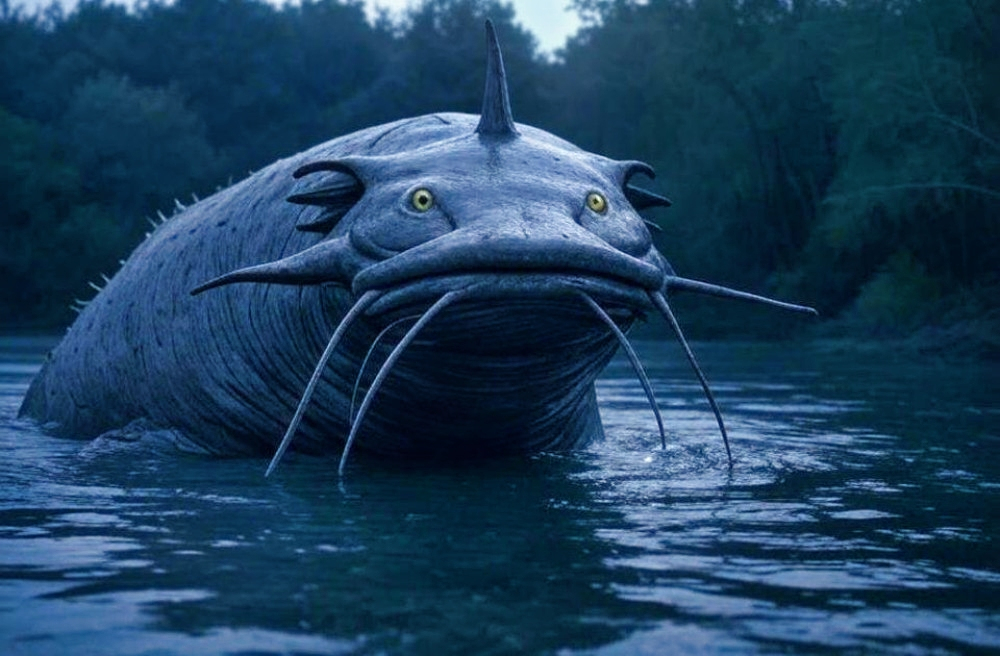
Forget Scotland’s Loch Ness Monster. Arkansas has its own aquatic celebrity, and ours has a wildlife refuge.
The White River Monster, affectionately known as “Whitey,” is said to inhabit the waters near Newport in Jackson County.
Reports of a strange creature in the White River date back to the early 20th century, with the legend gaining national attention in 1937 and again during the 1970s.
Witnesses have described a massive aquatic animal with gray skin, a broad back and an unusual appearance. Some accounts suggest the creature was as large as a railroad boxcar, which raises serious questions about what people were drinking along the river.
In 1973, the Arkansas General Assembly established the White River Monster Refuge near Newport, making it unlawful to molest, kill, trample or harm the creature within the designated area.
That’s right. Arkansas gave legal protection to a monster that nobody has conclusively proven exists.
Some researchers have suggested that sightings may have involved a large fish, an elephant seal or another unusual aquatic visitor.
We prefer to think Whitey is simply an Arkansas native who values privacy.
Outdoor survival tip: When paddling the White River, watch for submerged logs, changing currents and unusually large objects that appear to be breathing. If you spot Whitey, maintain a respectful distance. He’s practically a protected celebrity.
The Arkansas Gowrow: The Original Ozark Nightmare
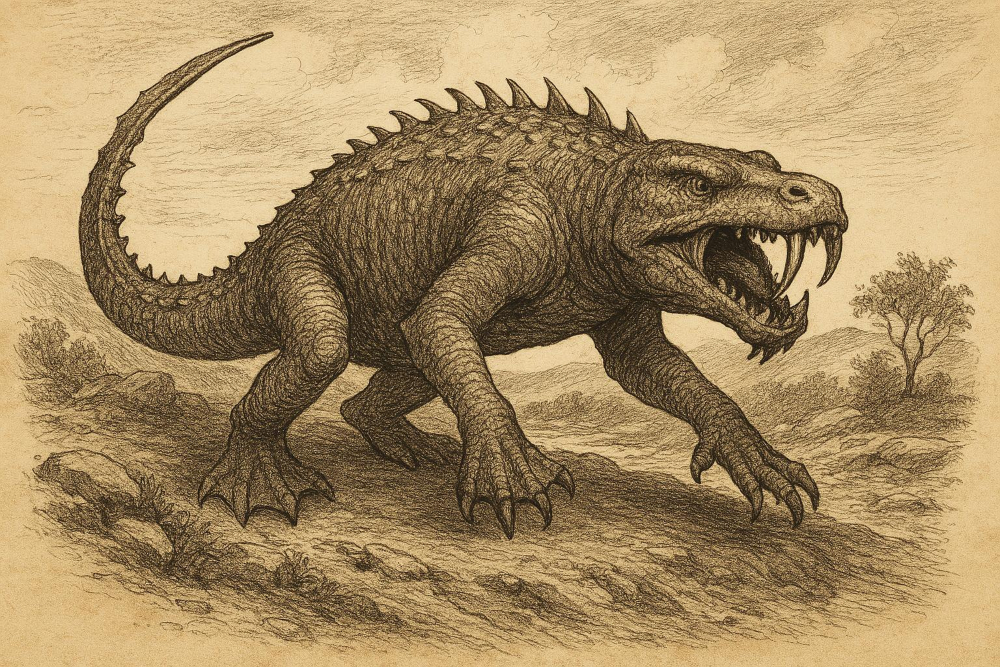
Long before Bigfoot became a household name, Arkansas had the Gowrow.
The creature gained attention in an 1897 newspaper account describing a terrifying beast reportedly discovered in the Ozarks.
According to the tale, the Gowrow was a monstrous animal with enormous tusks, horns, a powerful tail and a body resembling a bizarre combination of prehistoric reptile and angry livestock.
The beast supposedly took its name from the distinctive “gow-row” sound it made.
The original story claimed that a hunting party tracked and killed the creature after it terrorized local residents and livestock. Like many sensational newspaper stories of the era, however, the account was almost certainly a tall tale rather than a legitimate zoological discovery.
No verified Gowrow skeleton has ever surfaced, and modern scientists have stubbornly refused to add the creature to Arkansas’ official wildlife inventory.
Still, the Gowrow remains one of the state’s more entertaining contributions to American monster folklore.
Outdoor survival tip: If you encounter an animal with tusks, horns, claws and a massive tail, don’t waste time identifying it with your wildlife app. Just leave. Quickly.
The Boggy Creek Monster: The Fouke Monster That Became a Movie Star
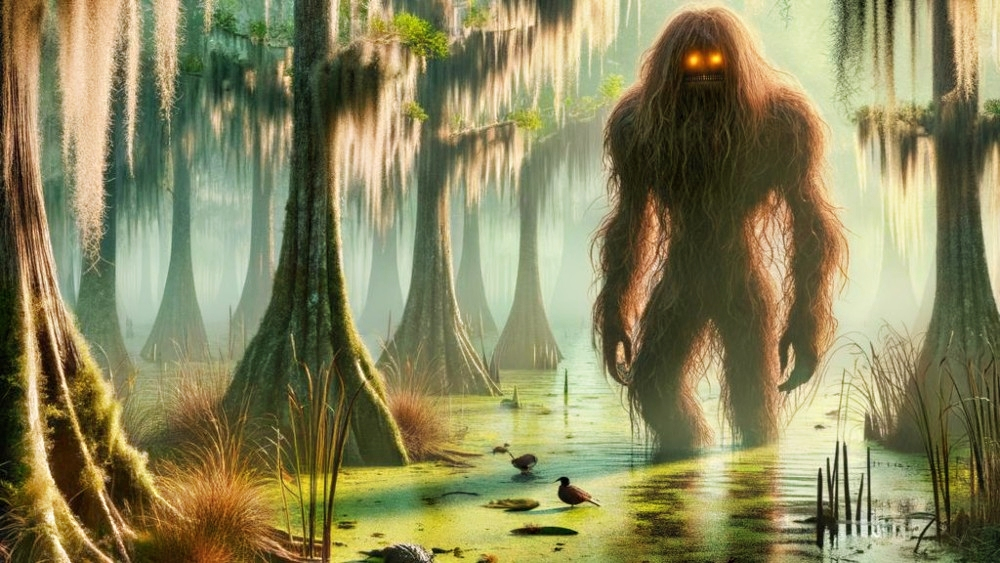
Perhaps Arkansas’ most famous cryptid, the Boggy Creek Monster, also known as the Fouke Monster, supposedly roams the swamps and bottomland forests near Fouke in southwest Arkansas.
Described as a large, hairy, humanlike creature, the monster became nationally famous following reported encounters around Fouke in the early 1970s.
The legend received an enormous publicity boost with the release of the 1972 film The Legend of Boggy Creek, directed by Arkansas filmmaker Charles B. Pierce.
The low-budget movie combined dramatized encounters with a documentary-style presentation, creating one of the most memorable regional monster films in American cinema.
It also helped establish an important rule of horror filmmaking: Never investigate a strange noise outside your cabin while wearing pajamas.
Reports of the creature have continued over the years, although no convincing scientific evidence has established the existence of a large, unknown primate in Arkansas.
Still, the Fouke Monster has become part of the state’s cultural identity, attracting curious visitors and cryptid enthusiasts to southwest Arkansas.
Outdoor survival tip: If you hear something enormous moving through the swamp, don’t automatically assume it’s Bigfoot. It could be a feral hog. Frankly, that might be worse.
The Sidehill Gouger: Evolution Took a Wrong Turn
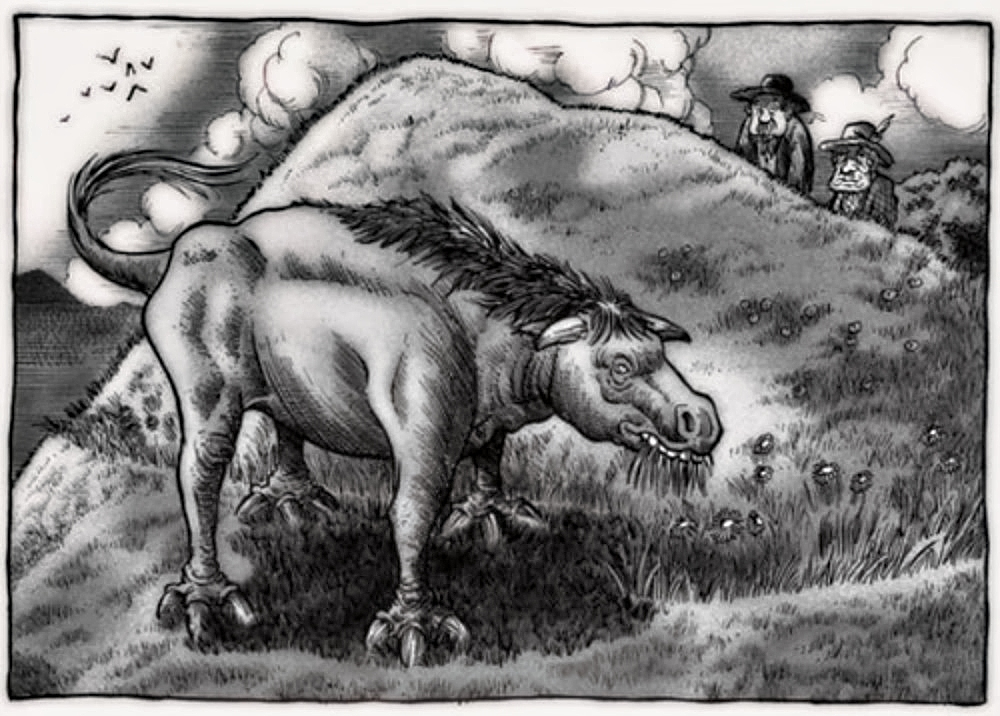
The Sidehill Gouger may be the most perfectly adapted creature ever invented by an Ozark storyteller.
According to regional tall tales, this peculiar animal has legs that are shorter on one side of its body than the other, allowing it to walk comfortably along steep mountain slopes.
Unfortunately, there’s a catch.
Because of its uneven legs, the Gouger can travel around a mountain in only one direction. Attempting to turn around would leave it hopelessly unbalanced, which seems like a serious evolutionary design flaw.
Similar creatures appear in logging camp folklore throughout North America, where they are often called Sidehill Gougers or Sidehill Dodgers. The Ozark version fits perfectly into a landscape filled with steep hillsides and people willing to tell an outrageous story with a straight face.
The creature’s unusual anatomy also raises several questions. How does it cross a valley? What happens when it reaches a road? And how does it find a mate traveling in the opposite direction?
Perhaps some mysteries are best left unanswered.
Outdoor survival tip: If you spot a Sidehill Gouger while hiking a steep Ozark trail, simply turn around and walk the other way. It probably can’t follow you. Just don’t ask it to demonstrate a switchback.
The Snawfus: The Most Beautiful Creature That Might Kill You
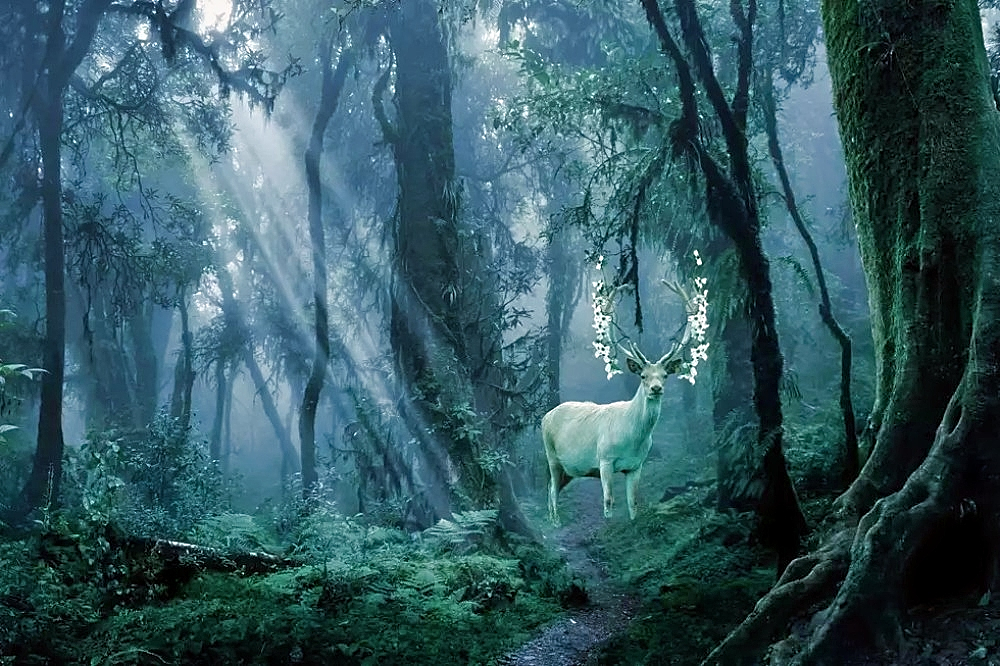
Not every Arkansas cryptid looks like something that crawled out of a swamp.
The Snawfus is described as a magnificent white deer, larger than an ordinary whitetail, with flowering dogwood or plum branches growing from its head instead of antlers.
If that sounds magical, wait until you hear the rest.
According to Ozark folklore recorded by folklorist Vance Randolph, the Snawfus can leap into trees, fly through the forest and exhale blue smoke. That smoke supposedly accounts for the blue haze that sometimes hangs over the Ozark Mountains.
Apparently, atmospheric science has been wasting everyone’s time.
The Snawfus also carries a more sinister reputation. Some traditional stories suggest that encountering the creature is an omen of impending death.
So, while it might look like the perfect subject for your next Instagram post, you may want to reconsider approaching it for a selfie.
One particularly entertaining origin story involves a hunter who ran out of bullets and loaded his rifle with plum pits. After shooting a white deer in the head, the animal escaped and later developed plum trees where its antlers should have been.
This is why ammunition manufacturers generally recommend using actual ammunition.
The Snawfus remains one of the Ozarks’ most distinctive legendary animals, combining the region’s natural beauty with its longstanding tradition of imaginative storytelling.
Outdoor survival tip: If you encounter a glowing white deer with flowering trees growing from its head, admire it from a distance. And if it starts breathing blue smoke, consider heading back to the trailhead. Your Instagram followers will understand.
The Arkansas Snipe: The Most Elusive Creature in the Woods
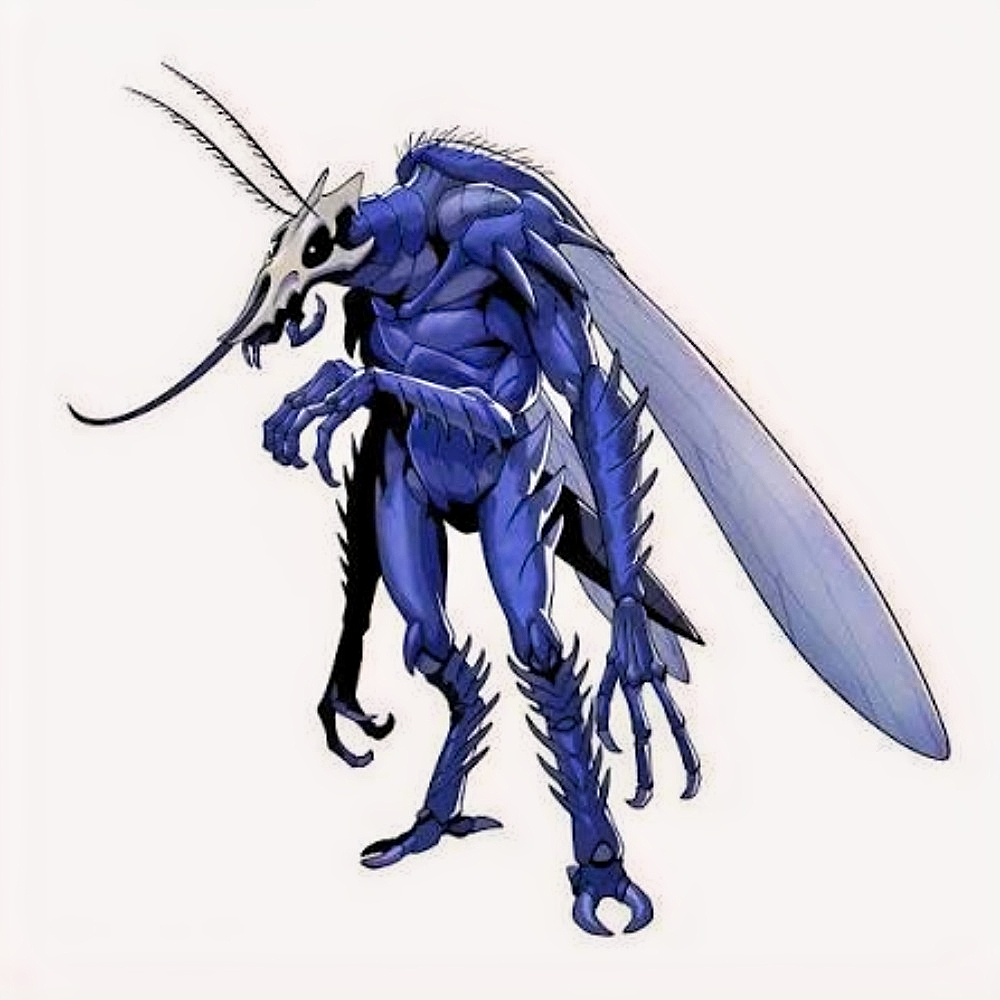
Of all the creatures on this list, the Arkansas Snipe may be the most frequently hunted and least frequently captured.
Unlike the other cryptids, snipes are real birds. Members of the sandpiper family, they inhabit wetlands and marshy areas, and their elusive behavior makes them challenging targets for birdwatchers and hunters.
But the Arkansas Snipe of campfire legend is something entirely different.
For generations, experienced campers, scout leaders and mischievous relatives have introduced newcomers to the time-honored tradition of snipe hunting.
The process usually involves taking an unsuspecting victim into the woods after dark, handing them a burlap sack and instructing them to wait quietly while the rest of the group drives the mysterious creatures toward them.
The more elaborate versions include special calls, unusual bait and detailed instructions about how to hold the sack.
Naturally, the experienced hunters eventually disappear, leaving the novice alone in the woods wondering why everyone else is laughing.
The Arkansas Snipe is especially dangerous because it can cause severe embarrassment, a lifelong distrust of camping companions and an unreasonable reluctance to hold burlap sacks.
No other cryptid on this list has such a consistent record of successfully capturing humans.
Outdoor survival tip: If someone invites you on a midnight snipe hunt and hands you a sack, congratulations. You are the entertainment. Bring a flashlight, a sense of humor and perhaps a better group of friends.
Are Arkansas Cryptids Real?
From the swamps of southwest Arkansas to the rugged mountains of the Ozarks, these legendary creatures are part of the Natural State’s storytelling tradition.
Some, like the Fouke Monster and White River Monster, have documented histories of reported sightings. Others, including the Gowrow, Snawfus and Sidehill Gouger, belong to a colorful tradition of tall tales, newspaper hoaxes and campfire folklore. The Arkansas Snipe, meanwhile, continues its proud tradition of making fools out of inexperienced campers.
There is no credible scientific evidence that any of Arkansas’ supposed mystery monsters represent an undiscovered species. But perhaps proving their existence isn’t really the point.
These stories add a little mystery to the places we already love exploring. They remind us of a time when the woods seemed larger, the nights seemed darker and every unexplained noise had the potential to become a legendary monster.
And Arkansas has plenty of real wildlife capable of producing strange sounds, unexpected encounters and the occasional reason to move quickly in the opposite direction.
So this Halloween, get outside. Take a hike through the Ozarks. Paddle a quiet river. Spend a night camping beneath the stars.
Just remember to pack the Ten Essentials, tell someone where you’re going and keep your camera ready.
Because somewhere out there, deep in an Arkansas forest, a creature may be watching you.
Or it might just be a raccoon.
Happy Halloween from Arkansas Outside. Stay spooky, stay safe and whatever you do, don’t volunteer to hold the snipe sack.