
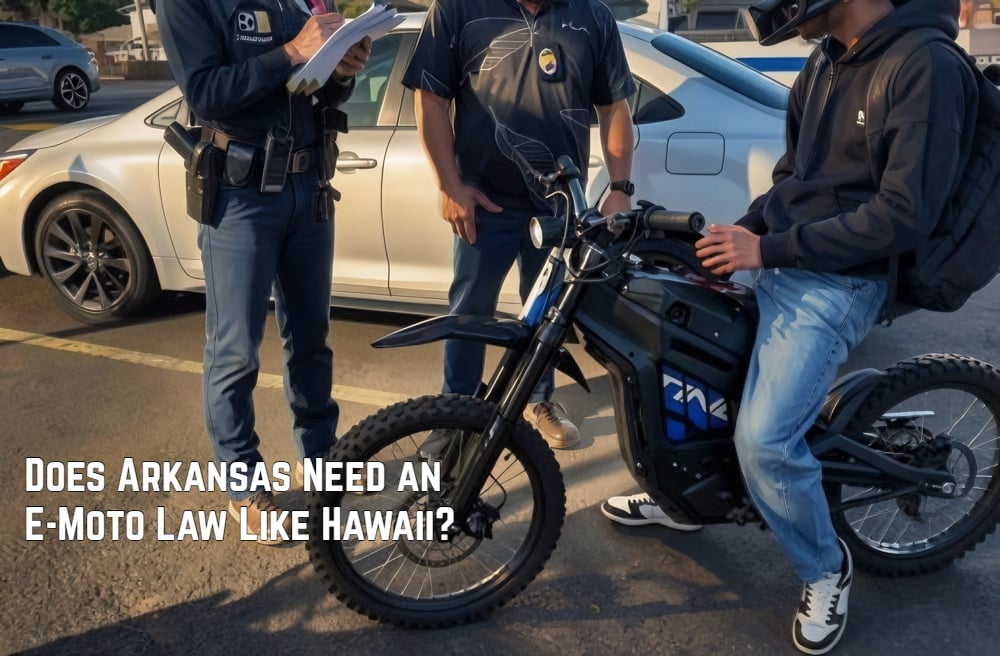

Electric bicycles have become a common sight on Arkansas roads, trails, and greenways. They have opened cycling to older riders, commuters, people with disabilities, and outdoor enthusiasts who simply want to ride farther. At the same time, another type of electric two-wheeler has exploded in popularity: high-powered electric motorcycles, commonly referred to as e-motos.
The problem is that many people, and even some retailers, blur the line between an electric bicycle and an electric motorcycle. That confusion has created safety concerns, conflicts on trails, and uncertainty for law enforcement across Arkansas.
Now, Hawaii has become the latest state to tackle the issue directly. The question is whether Arkansas should follow its lead.
What Hawaii Just Did
Earlier this month, Hawaii approved legislation that clearly separates electric bicycles from high-powered electric motorcycles, often marketed as e-motos. The law creates distinct definitions, establishes operating rules, and prohibits high-speed electric devices from being operated on public bicycle infrastructure and other areas intended for bicycles and pedestrians. It also requires clearer labeling so consumers understand exactly what they are buying.
Perhaps the most significant change is that devices lacking functional pedals, exceeding bicycle power limits, or capable of much higher speeds are no longer treated as bicycles. Instead, they are regulated separately.
That distinction is becoming increasingly important nationwide.
Arkansas Already Has E-Bike Laws
Arkansas adopted the widely recognized three-class e-bike system several years ago. Under state law:
- Class 1 e-bikes provide pedal assist only, up to 20 mph.
- Class 2 e-bikes include a throttle but are limited to 20 mph.
- Class 3 e-bikes provide pedal assist up to 28 mph.
These bicycles are limited to 750 watts of motor power and must have fully operable pedals.
Arkansas Outside recently examined how cities around the state regulate e-bike use. While state law provides the basic framework, local governments and trail managers have adopted a patchwork of rules concerning where various classes of e-bikes may operate.
That system generally works well for legitimate electric bicycles.
The challenge is that many of today’s popular e-motos do not fit within those definitions.
The Rise of the E-Moto
Models such as the Sur-Ron, Talaria, and similar machines are often marketed alongside electric bicycles despite having characteristics much closer to lightweight motorcycles.
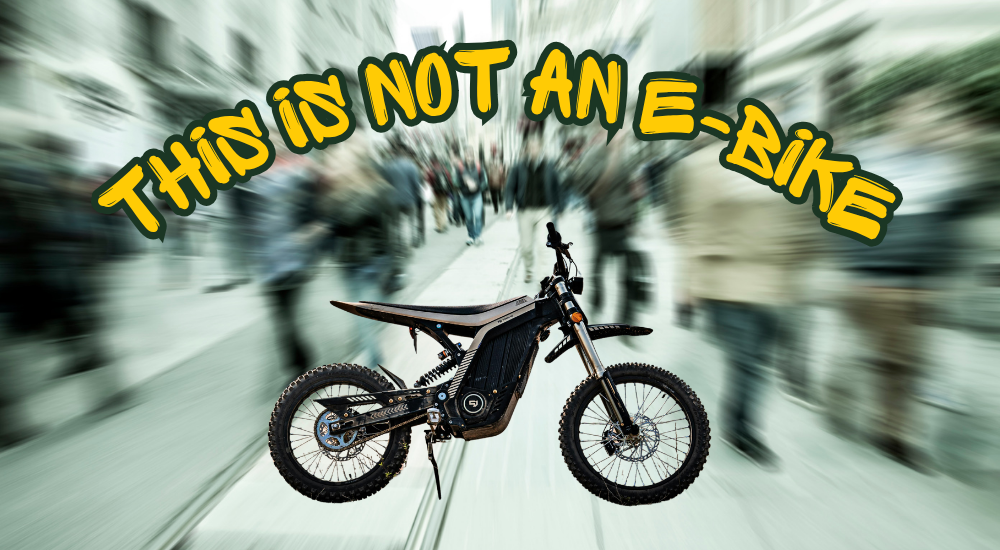
Many feature:
- Motors producing several thousand watts.
- Top speeds of 40 to 60 mph or more.
- Motorcycle-style frames and suspension.
- Foot pegs instead of usable pedals.
- Weight approaching that of small dirt bikes.
Although some versions include pedals, they are often ornamental rather than practical.
The result is confusion among buyers who assume that because the vehicle is electric, it may be used anywhere bicycles are allowed.
A California Crash Offers a Warning for Arkansas
Earlier this year, Arkansas Outside reported on the arrest of a California parent following a serious crash involving a juvenile operating a high-powered electric motorcycle. Although the incident did not occur in Arkansas, it illustrates the safety and legal questions that can arise as increasingly powerful e-motos become available to younger riders.
The California case raised concerns about parental responsibility, rider age, supervision, and the operation of electric motorcycles on public streets. It also showed the consequences of treating a motorcycle-capable machine as though it were an ordinary electric bicycle.
Arkansas has not experienced this specific case, but similar e-motos are already being sold and ridden in the state. The California crash offers a warning about the problems Arkansas could face without clearer vehicle classifications, age requirements, operating rules, and guidance for parents, retailers, riders, and law enforcement.
Trail Managers Are Already Responding
The debate is not limited to public roads.
Several Arkansas trail systems have begun addressing the issue independently.
As Arkansas Outside previously reported, managers of several trail networks have restricted or prohibited Sur-Ron style electric motorcycles because of concerns involving rider speeds, trail damage, user conflicts, and overall safety.
Those restrictions are not aimed at traditional Class 1 e-bikes that have become common among mountain bikers and recreational riders.
Instead, they focus on machines capable of motorcycle-like performance using trails designed for bicycles, hikers, and runners.
Without statewide definitions, each land manager is left creating its own policies.
Why Clear Definitions Matter
For cyclists, one of the biggest concerns is that irresponsible operation of high-powered e-motos could damage public acceptance of traditional e-bikes.
Most Class 1 e-bikes are simply bicycles with electric assistance. They travel at speeds similar to many experienced cyclists and have become valuable tools for recreation, transportation, and accessibility.
E-motos represent an entirely different category of vehicle.
When the public cannot distinguish between the two, complaints about reckless riding often affect all electric bicycles.
That creates unnecessary conflict and can lead to restrictions on riders who are following the rules.
What Could Arkansas Learn From Hawaii?
Hawaii’s new law attempts to eliminate that confusion by clearly defining what qualifies as an electric bicycle and what qualifies as an electric motorcycle or high-speed electric device. It also requires manufacturers and retailers to accurately identify products so consumers know how they may legally be used.
Arkansas could consider similar measures, including:
- Creating a legal definition for e-motos separate from e-bikes.
- Requiring manufacturers and retailers to accurately label vehicles.
- Clarifying where e-motos may legally operate.
- Providing guidance for law enforcement.
- Creating consistent statewide standards for public trails and greenways.
Such legislation would not necessarily ban e-motos. Instead, it would recognize that they are fundamentally different vehicles requiring different rules.
There Are Questions to Consider
Any new legislation would also raise important questions.
Would riders need registration, insurance, or a driver’s license?
Should certain public lands allow e-motos while others prohibit them?
How would the rules affect private property, off-highway vehicle parks, and designated motorized trails?
Should existing motorcycle laws simply be expanded to include electric versions?
Those questions deserve careful discussion involving cyclists, trail managers, outdoor recreation advocates, law enforcement, retailers, and e-moto owners.
The Bottom Line
Arkansas has done a good job establishing clear rules for electric bicycles, but technology is evolving faster than state law.
As powerful electric motorcycles become more common, the line between bicycle and motorcycle continues to blur.
The incidents already occurring on Arkansas roads and trails suggest the state may soon need clearer definitions, not to discourage innovation, but to protect legitimate e-bike riders, improve public safety, reduce confusion, and ensure that every type of electric vehicle is operating under rules appropriate for its capabilities.
Hawaii has chosen to draw that line.
The question now is whether Arkansas should do the same.
This article was originally published on ArkansasOutside.com, your trusted source for outdoor news and updates in The Natural State. Unless otherwise credited, all photos included in this piece are the property of Arkansas Outside, LLC. We take pride in sharing the beauty and adventures of Arkansas through our lens—thank you for supporting our work!