
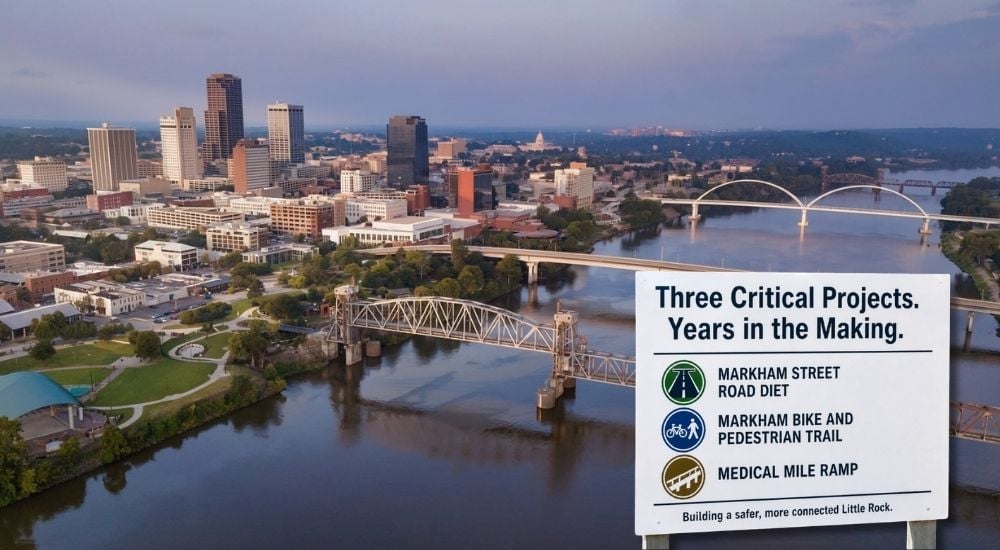

Last week, Little Rock announced that the damaged pedestrian bridge over Markham Street serving the Arkansas School for the Deaf and Arkansas School for the Blind will be demolished, with no plans to replace it. For many who walk, bike, or roll through the city, the announcement was another reminder that pedestrian infrastructure often receives far less urgency than projects focused on moving automobiles.
That decision also puts renewed attention on three long planned transportation projects that have already secured funding and continue to inch toward construction after years, and in some cases decades, of planning. Together, they represent some of the most important missing links in Little Rock’s bicycle and pedestrian network.
While each project has made measurable progress, none is complete, leaving residents to continue navigating corridors that planners have long recognized as needing improvement.
Markham Street Road Diet: Nearly a Decade of Planning
The Markham Street Road Diet between Cedar Street and Pearl Avenue has been under discussion for nearly ten years as one of Little Rock’s most significant pedestrian safety improvements.
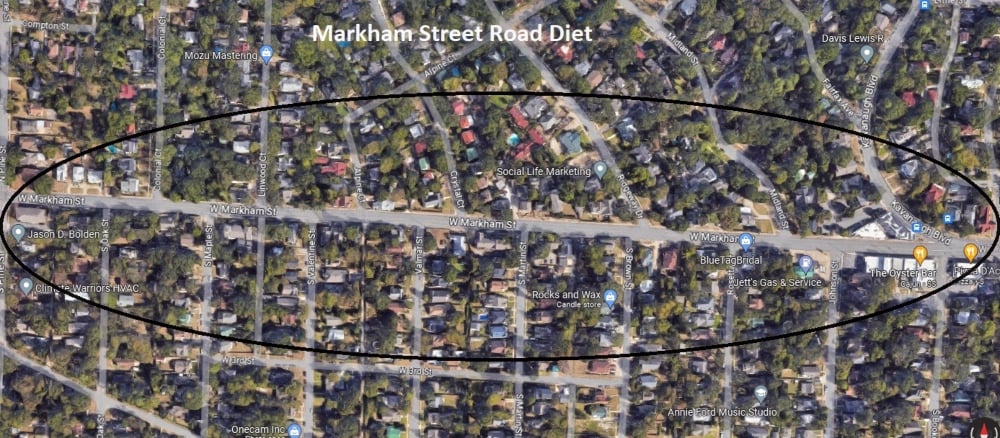
The proposal would convert the existing four lane roadway into a three lane configuration with one travel lane in each direction, a center turn lane, improved sidewalks, ADA upgrades, landscaping, streetscape improvements, and safer pedestrian crossings.
The corridor connects neighborhoods, businesses, the University of Arkansas Medical School, and the Arkansas School for the Deaf and Blind. It also fills one of the city’s most important gaps in its pedestrian network.
Although the concept has existed for years, the project did not receive a major boost until 2024 when Metroplan awarded approximately $1.1 million in Transportation Alternatives Program funding.
Even after funding was secured, years of engineering, environmental review, utility coordination, right of way acquisition, and state and federal approvals remained before construction could begin.
Today, the project has entered one of its final preconstruction stages.
According to the Little Rock Mayor’s Office, acquisition notices have been sent to affected property owners. Once valuations are approved by ARDOT, negotiations can begin. The city expects right of way certification to be completed by the end of 2026, allowing ARDOT to authorize bidding during the first quarter of 2027.
Construction is expected to last approximately 18 months.
For residents who have followed the project since its earliest public meetings, this represents the closest the Road Diet has ever come to construction. (City Link)
Markham Bike and Pedestrian Trail: Another Missing Link
Running alongside the Road Diet is another long awaited project.
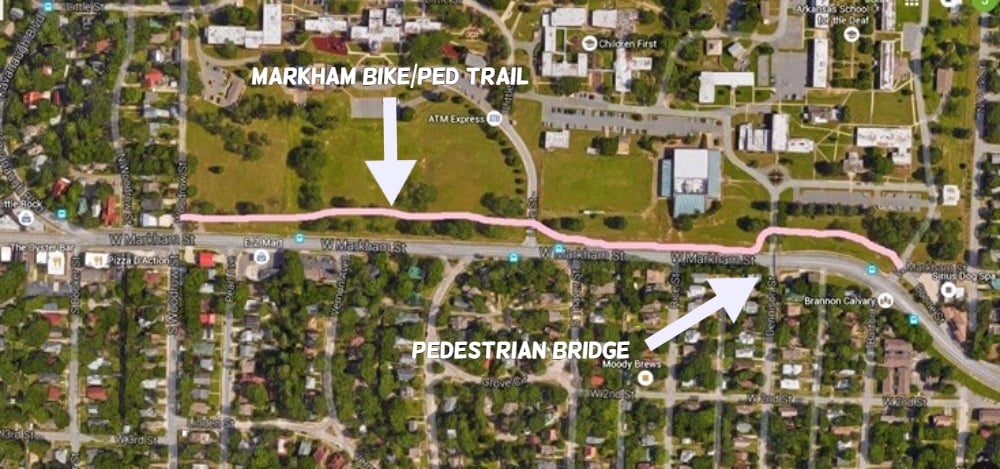
The Markham Bike and Pedestrian Trail will create a shared use path along the north side of West Markham Street between Boone Street and Woodrow Street, directly in front of the Arkansas School for the Blind and Arkansas School for the Deaf.
Although relatively short, the trail addresses one of the city’s most difficult east west transportation gaps.
The Union Pacific Railroad corridor creates a significant barrier between downtown Little Rock and central neighborhoods. Transportation planners have long identified this area as one of the weakest links in the city’s bicycle network.
The project has remained on the City’s BikePed project list for years while officials worked through funding and negotiated easements with adjacent property owners.
According to the Mayor’s Office, the next year will be spent completing final design and right of way acquisition. Construction is currently anticipated to begin in late 2027 and require approximately nine months to complete.
Ward 3 Director Kathy Webb has indicated that final coordination among the City, Arkansas Department of Education, Public Works, and other partners is underway, saying simply, “It is happening.”
If the current schedule holds, the trail could finally open in 2028. (City Link)
Medical Mile Ramp: A Small Project That Has Taken Nearly Two Decades
Perhaps no project better illustrates the slow pace of transportation infrastructure than the Medical Mile Ramp.
The Medical Mile itself opened in 2006 as one of the nation’s first urban wellness trails, quickly becoming a popular destination for walkers, runners, cyclists, and rehabilitation patients.
Yet nearly twenty years later, one of its most important connections still has not been completed.
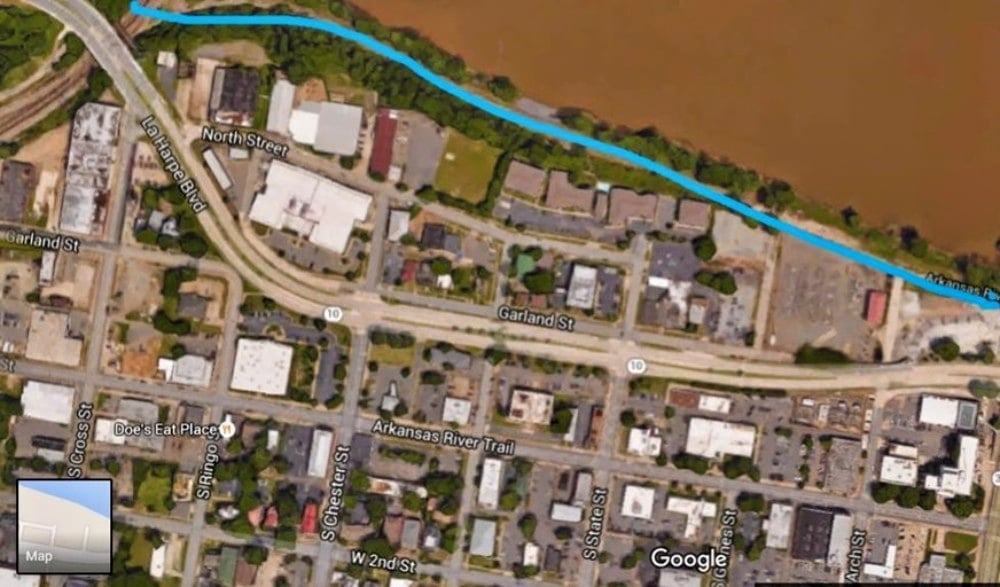
The missing ramp would connect the Medical Mile directly to the Arkansas River Trail near North Street and Cantrell Road, eliminating one of the trail system’s most awkward transitions.
Today, users traveling west from the Medical Mile must navigate roadway segments, commercial driveways, and crossings that many cyclists and pedestrian advocates consider among the least comfortable sections of the Arkansas River Trail.
The project has spent years working through railroad coordination, environmental documentation, engineering design, right of way acquisition, and numerous state and federal approvals before construction could begin.
The project recently cleared one of its biggest hurdles when ARDOT approved right of way certification.
According to the Mayor’s Office, bids are expected to be advertised during the third quarter of this year. Construction could begin during the fourth quarter and require approximately 18 months.
While the ramp itself covers only a relatively short distance, it removes one of the Arkansas River Trail’s most significant barriers and represents another important step toward completing the regional trail network.
Even after it opens, however, the Arkansas River Trail west of the Medical Mile will still not be fully completed, meaning users will continue encountering roadway segments until future trail projects are built. (City Link)
A Pattern of Progress, Measured in Years
Taken individually, each of these projects tells a familiar story.
Planning begins with a promising vision. Funding is eventually secured. Then follow years of design, engineering, property acquisition, environmental review, agency coordination, and regulatory approvals before construction can finally begin.
Collectively, however, they illustrate something larger.
Little Rock has demonstrated a long term commitment to expanding its bicycle and pedestrian network, but that commitment has often unfolded at a pace measured in decades rather than years.
That reality feels especially significant following the decision to remove the Markham Street pedestrian bridge without replacing it.
Residents are being asked to wait for new crossings, safer streets, and improved trail connections while existing pedestrian infrastructure disappears.
To the city’s credit, all three funded projects are now closer to construction than at any point in their histories. If current schedules hold, work on the Medical Mile Ramp could begin later this year, while both Markham projects move toward construction beginning in 2027.
For those who have spent years advocating for safer walking and bicycling infrastructure, that progress is encouraging.
The challenge, however, is that Little Rock’s active transportation network is still defined as much by its missing links as by its completed ones. Until those gaps are finally closed, residents will continue experiencing a transportation system where many of the safest routes remain plans on paper rather than paths on the ground.
This article was originally published on ArkansasOutside.com, your trusted source for outdoor news and updates in The Natural State. Unless otherwise credited, all photos included in this piece are the property of Arkansas Outside, LLC. We take pride in sharing the beauty and adventures of Arkansas through our lens—thank you for supporting our work!