

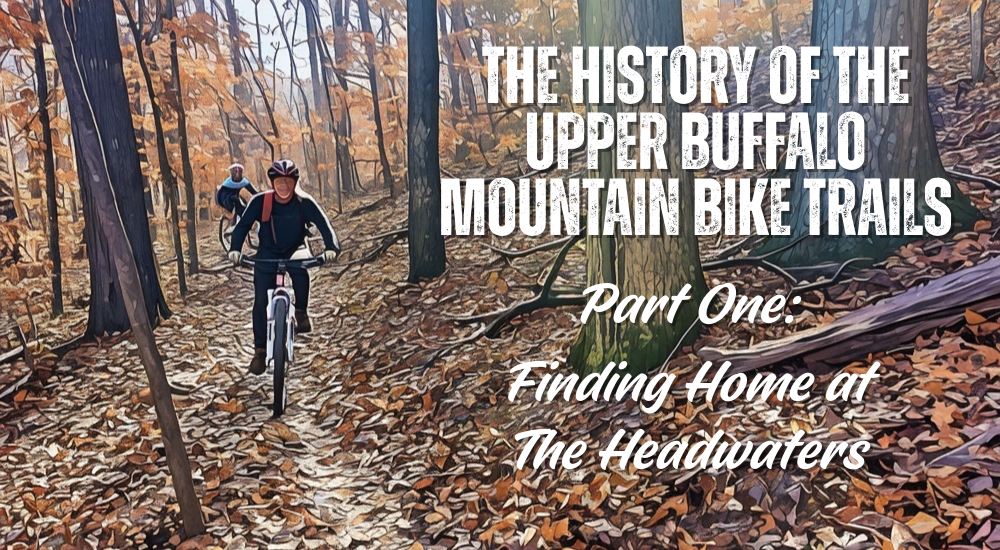

Finding Home at the Headwaters
Introduction
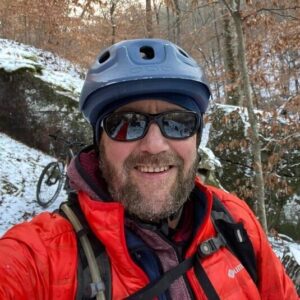
The history of the Upper Buffalo Mountain Bike Trails begins long before the first tire touched the rocky soil. It started with a young couple traveling the country, falling in love with a place they barely knew, and gradually becoming part of a remote mountain community. This is the opening chapter, rich with exploration, friendships, and the early seeds of a life dedicated to the Buffalo Headwaters. Thanks to How Kuff for sharing this three part series that features an important part of mountain bike history in Arkansas. Each part will be presented on Monday’s throughout December. Also, remember you can experience these trails first hand at the 21st Annual Buffalo Headwaters Challenge in January, 2026.
A Hitchhiking Journey and a First Glimpse of the Ozarks
In the spring of 1978, I set out on a hitchhiking trip with my girlfriend. We left our college in northern Wisconsin, while it was still trapped in winter, and headed toward the promise of sun and sand on South Padre Island. We carried everything on our backs. We wanted adventure, warmth, and experience, and hitchhiking offered all three.
One evening, after several long rides, we were dropped off on Highway 71 at the intersection of College Avenue and Dickson Street in Fayetteville. We walked down the street with our packs, passing small shops, restaurants, and a lively college crowd. A bar with live music drew us in. We dropped our backpacks, danced, listened, and sipped drinks with strangers who quickly became friends. Someone offered us a place to stay, so we found ourselves sleeping that night in a home on Mt. Sequoyah.
The next morning, we were back on the highway. That stop in Fayetteville could have been forgettable, just a waypoint on a much longer journey, but it had a pull we did not yet understand. The months that followed took us thousands of miles, from the Gulf of Mexico to the deserts of the Southwest, across the border into Baja California, up the Pacific Coast, through Oregon, Washington, Montana, North Dakota, and Minnesota, and finally back to Wisconsin. But the Ozarks stayed in our minds.

A Return and a New Direction
We returned to Northwest Arkansas the following year, this time in a classic VW Microbus with no real plan other than to explore the back roads and communities we had heard about. There were rumors of young people homesteading in the Boston Mountains, building simple homes, living off the land, forming intentional communities, and creating their own way of life far from cities.
One afternoon, we stopped at a pizza restaurant near the Fayetteville Square. The owner told us about a small community in Newton County near Fallsville. He described a little hippie store, a community gathering barn, artists, back-to-the-land families, and mountain people carving out a different kind of existence. The place sounded magical.
The drive into the mountains was everything he promised. Rolling ridges opened to deep forested valleys, all washed in the soft light of late fall. We stopped at the store and chatted with the owners for several hours. Their warmth was immediate. They invited us to stay for dinner. A few hours later, after more food, more visiting, and a little drinking and smoking, they asked us to spend the night on their 150-acre homestead.
We spread sleeping pads in the yard. The December sky above us burst with stars from horizon to horizon. The night was perfectly still. It felt like the entire Ozark forest was breathing around us. It was one of those rare nights in life where the world feels wondrous and unfamiliar, as if it is inviting you to stay.
Discovering the Heart of the Buffalo Headwaters
In the morning, we studied maps and realized we were at the very top of the Buffalo National River. The Buffalo Fire Tower, the highest point in the Ozarks, was just a short distance away. The small community of Red Star was not far. We had landed in one of the most rugged and remote regions in Arkansas without even knowing it.

We stayed a whole week. We camped in the yard, visited neighbors, explored old logging roads and deer trails, and hiked to creeks and hollows that felt untouched. We met other members of the mountain community who had come here for the same reasons we found ourselves returning: beauty, solitude, connection, and possibility.
Over the next two years, we kept coming back, each time staying longer. Our circle of friends grew. We learned more about local families, homesteaders, and the history of the headwaters. We became part of the small but vibrant community scattered across the high ridges.
A Homestead Takes Root
Eventually, the owners of the 150-acre farm offered to sell us land so we could become their neighbors. We were finishing degrees and teaching in Minneapolis at the time, but the offer sparked something in both of us. Life in the city had advantages, but the pull of the mountains was stronger.
We bought 10 acres of what can only be described as exceptional land. The property included an extraordinary spring nestled in a botanically rich, east-facing hollow that felt like a sanctuary. Later, we added another 10 acres. Our land bordered the Ozark National Forest, which at the top of the Buffalo included about 10,000 primarily roadless acres containing the watersheds of three creeks that merge to form the Buffalo National River. These were Big Buffalo Creek, Knuckles Creek, and Reeves Fork.
We began to build a homestead from the ground up. We raised cows, pigs, goats, chickens, and horses. We grew extensive gardens and farmed organically on a small commercial scale. We delivered our children at home and raised them within this landscape. Our solar-powered home became the center of our lives. The mountains shaped our days. The forest shaped our values.
As our community grew, we helped create a small local school for homeschooling families. The school focused on individual learning rates, outdoor activities, environmental education, arts, math, and science. Children learned by doing. They spent time outdoors. They explored forests and creeks. They built, experimented, and discovered.
Life was good, meaningful, and full.
The Threat Arrives
All of that changed in the spring of 1990 when a letter arrived from the U.S. Forest Service. They planned to bulldoze roads, clear-cut large areas of forest, and spray herbicides throughout the Buffalo Headwaters to encourage commercially valuable tree species.
This was not theoretical. I had hiked the area constantly for years and had seen the aftermath of previous timber harvests. Clearcuts left the land scarred and open. Bulldozed roads cut deep into slopes. Drought and heavy rain exaggerated erosion. Habitat degraded. Water quality declined. Dense thickets and invasive species overtook once rich hardwood stands.
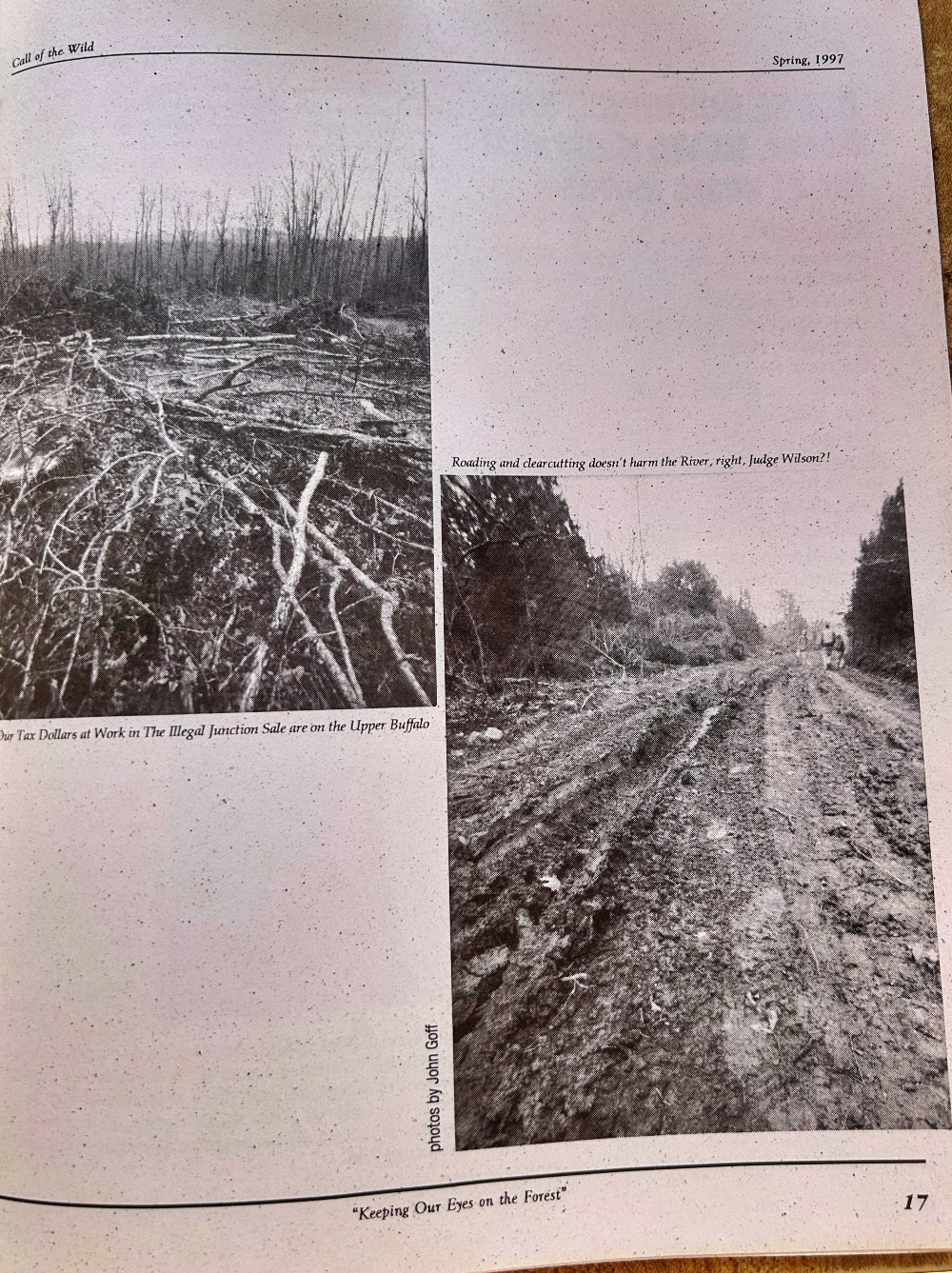
One place in particular broke my heart. There was an ancient beech forest that I had visited for years. In fall and winter, the silver bark glowed against the understory, and the leaves shimmered like gold. After one logging operation, I returned to find it gone. Every tree had been cut and left to rot because beech had no market value. It looked like a battlefield.
The upper Buffalo had just been federally designated as a Wild and Scenic River, but this timber sale showed no respect for that protection.
I knew immediately that I had to act.
Stepping Into Leadership During a Decade of Conflict
I became deeply involved in opposing the timber project. I joined the Newton County Wildlife Association and eventually served as its president. The group had a long history of advocating for wildlife and responsible public land management.
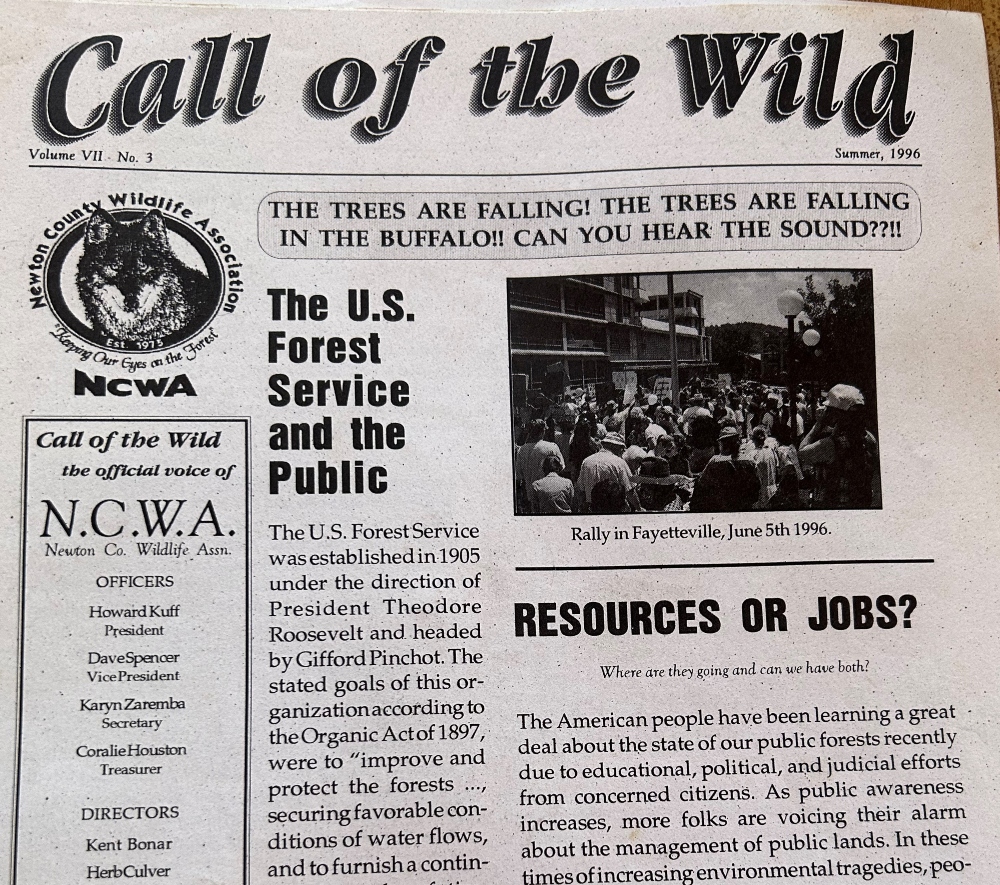
I immersed myself in forest policy and public land law. I networked with national environmental organizations. I attended conferences, workshops, and strategy meetings. We advocated for single tree selection, reduced motorized access, an end to glyphosate-based herbicides, stronger watershed protections, and better monitoring. We pushed for dispersed recreation rather than high-impact logging roads.
The conflict lasted through the entire 1990s. It turned violent at times. A close friend was pulled from his cabin and beaten so severely that he suffered broken ribs and severe bruising. Later, his home was burned to the ground.
There were three federal lawsuits. Two were in Little Rock. One was in Fayetteville. I was the plaintiff in the Little Mulberry Headwaters Timber Sale case that lay directly across the highway from the Buffalo Headwaters. I represented myself, argued the case, and won a federal injunction that halted the sale for a year. A higher judge later overturned the ruling, deferring to the Forest Service as the supposed experts.
We held public meetings, gave speeches, created outreach campaigns, pressured politicians, and organized demonstrations both in the national forest and at Forest Service offices. In Fayetteville, we held a six-hundred-person protest in front of the Federal Building, complete with theater, giant puppets, and fiery speeches.
It was a decade of nonstop work.
Amid that struggle, something new was about to enter my life. Something that would shift the direction of my energy and ultimately help define the future of the Buffalo Headwaters.
Conclusion
The fight to defend the forest created a deep connection to the Buffalo Headwaters. But in 1993, during the height of tension and activism, a discovery appeared that would reshape everything. It arrived as a mountain bike.
Next Installment Teaser
Part Two dives into the moment mountain biking entered the story, how old homestead roads became trail corridors, and how a small group of riders began piecing together what would become one of Arkansas’ most iconic mountain bike trail systems. Read part two here on ArkansasOutside.com.

Images courtesy of How Kuff.
This article was originally published on ArkansasOutside.com, your trusted source for outdoor news and updates in The Natural State. Unless otherwise credited, all photos included in this piece are the property of Arkansas Outside, LLC. We take pride in sharing the beauty and adventures of Arkansas through our lens—thank you for supporting our work!

3 Responses
For the record, How Kuff has a knack for storytelling, in my opinion, this is absolutely great. Anyone that has been there, and is paying attention to themselves, knows exactly the pull that he describes — it’s unlike anything else. As a mountain biker, I am excited to read more!
I thoroughly enjoyed this article, How is a great writer and an even better person, so smart and dedicated to the right and just causes we should support, love this and can’t wait for the next one, thanks How!
How…This literally gave me chills. You’re writing is incredible and captures the heart and essence of the Ozarks and Arkansas. People think I am crazy when I say that I want to live here forever, but it’s true. I have traveled, a lot. Seen a lot. But this place is home and draws me back. Thanks for sharing. 🙂