
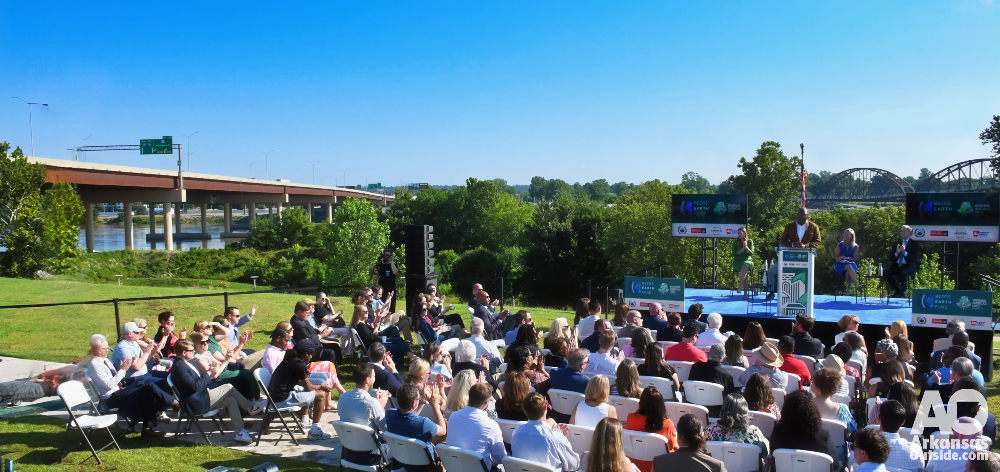

Little Rock’s vision of transforming land created by the Interstate 30 reconstruction into one of the nation’s premier urban parks took a major step forward Tuesday morning with the announcement of a $30 million grant from the Bezos Earth Fund.
The award, one of the largest private investments ever made in a public park project in Arkansas, will help fund development of 30 Crossing Park, a planned 23-acre urban green space that will reconnect neighborhoods divided by interstate construction while creating a destination for recreation, community gatherings, and economic development. The grant is part of the Bezos Earth Fund’s new Greening America’s Cities initiative, which is investing $100 million in eight cities across the country to transform underused urban land into parks and natural spaces.
City, state, business, and federal leaders gathered Tuesday morning in downtown Little Rock to celebrate what many described as a once-in-a-generation opportunity.
A Promise Coming Full Circle
Mayor Frank Scott Jr. opened the event by reflecting on the public meetings surrounding the Interstate 30 Crossing project more than a decade ago.
He reminded the audience that residents demanded more than a highway expansion.
“We said this project would be about more than moving traffic,” Scott said. “We promised that by listening to the public, we could create an active urban green space that reconnects neighborhoods and improves quality of life while advancing transportation.”
Scott described the announcement as the result of years of collaboration among the City of Little Rock, the Arkansas Department of Transportation, state leaders, federal officials, and community partners.
“Today we stand before you recognizing that we have a once-in-a-lifetime opportunity to create 30 Crossing Park,” he said.
Connecting Nature and Community
Governor Sarah Huckabee Sanders said the project aligns closely with Arkansas’s growing emphasis on outdoor recreation and conservation.
She noted that access to parks and outdoor spaces has become increasingly important as children spend more time indoors.
Citing research shared by Outside magazine’s leadership, Sanders said today’s children spend less time outdoors than previous generations, contributing to growing concerns about physical and mental health.
“The Bezos Earth Fund is taking on that challenge by helping create a destination park in the heart of Arkansas’s largest city,” Sanders said.
She praised the decision to turn land made available by the I-30 reconstruction into public green space rather than commercial development.
“I’m grateful that our community chose to create a park, not just for the surrounding neighborhoods, but for everyone across Central Arkansas and beyond.”
Sanders also connected the project to the recently announced Maumelle Pinnacles Master Plan, saying both efforts demonstrate Arkansas’s commitment to expanding outdoor recreation while protecting natural resources.
Bezos Earth Fund Sees Opportunity in Cities
Tom Taylor, president of the Bezos Earth Fund, traveled to Little Rock to announce the award.
Taylor explained that Jeff Bezos and Lauren Sánchez Bezos created the Earth Fund six years ago based on the belief that while humanity has made remarkable progress over the past century, protecting nature remains one of society’s greatest challenges.
“We need to take care of it,” Taylor said while describing the organization’s mission of restoring natural spaces where people live.
The Little Rock grant is part of the Earth Fund’s Greening America’s Cities initiative, which supports projects that convert vacant, underused, or infrastructure-adjacent land into accessible green spaces designed to improve environmental resilience and public health.
More Than a Park
Ruth Whitney, Chair of the Little Rock Regional Chamber, emphasized that 30 Crossing Park represents much more than a recreational amenity.
“For decades, cities built infrastructure and businesses followed,” Whitney said. “Today, the rules have changed.”
She noted that today’s workforce increasingly chooses communities based on quality of life, access to nature, walkability, and public gathering spaces.
“That is why 30 Crossing Park is far more than a parks project,” she said. “It is a flagship economic development project.”
The park is expected to become a centerpiece of downtown redevelopment while supporting nearby neighborhoods, attracting visitors, and encouraging additional private investment.
A Park Years in the Making
The vision for 30 Crossing Park emerged during planning for the Arkansas Department of Transportation’s Interstate 30 Crossing reconstruction.
Public feedback throughout the highway project consistently emphasized reconnecting neighborhoods that had been divided by interstate construction while creating new public space in the heart of downtown.
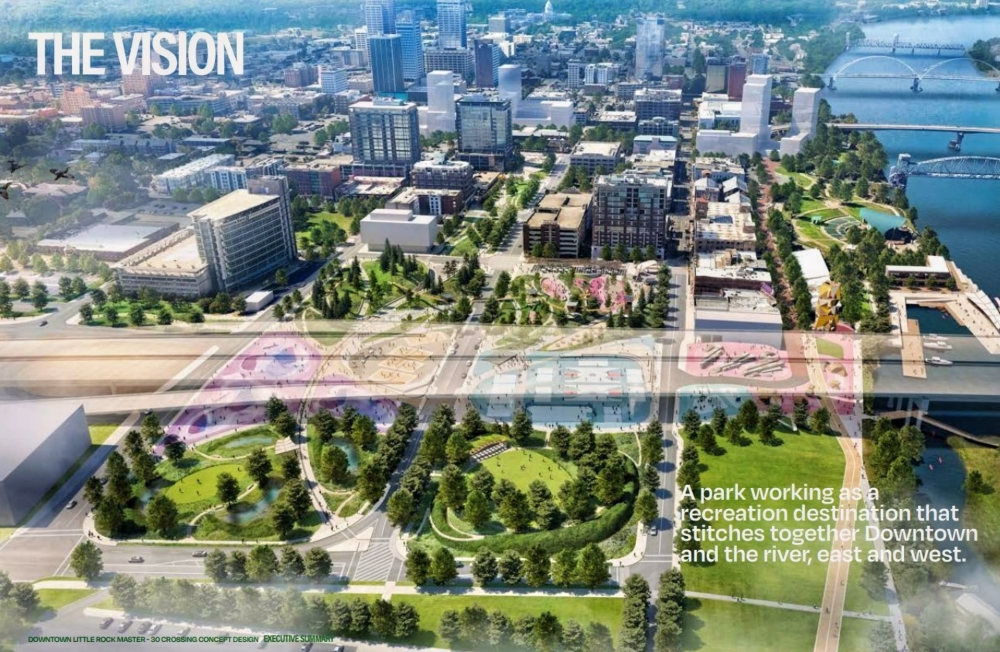
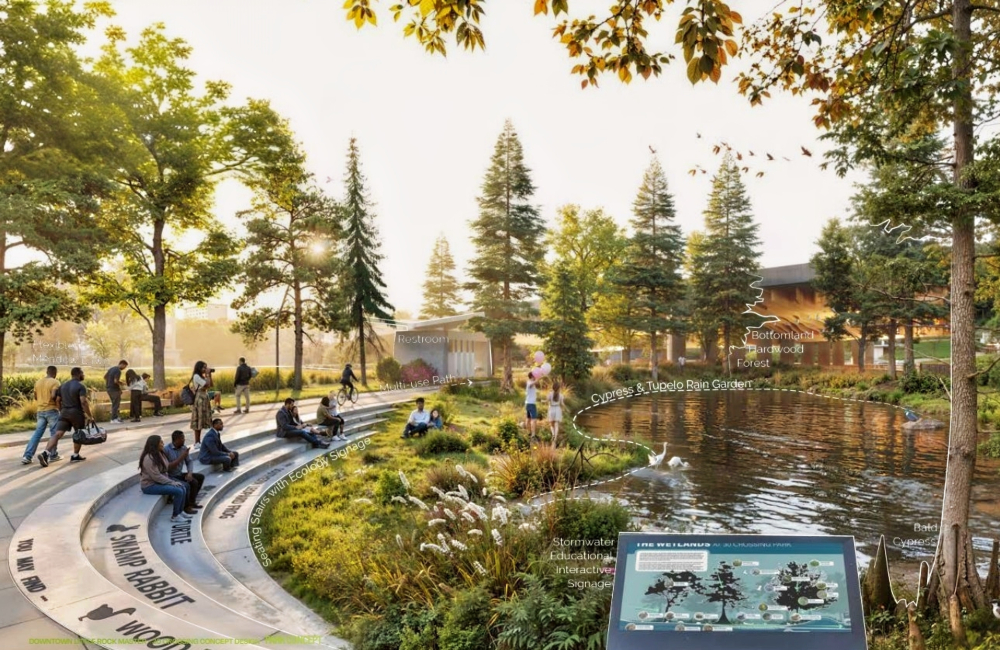
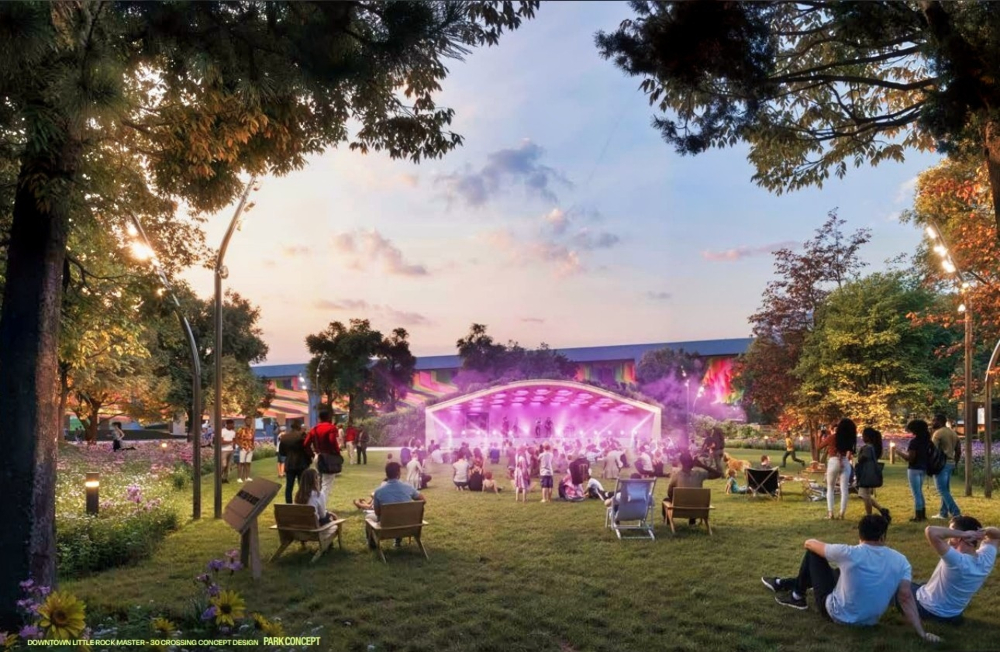
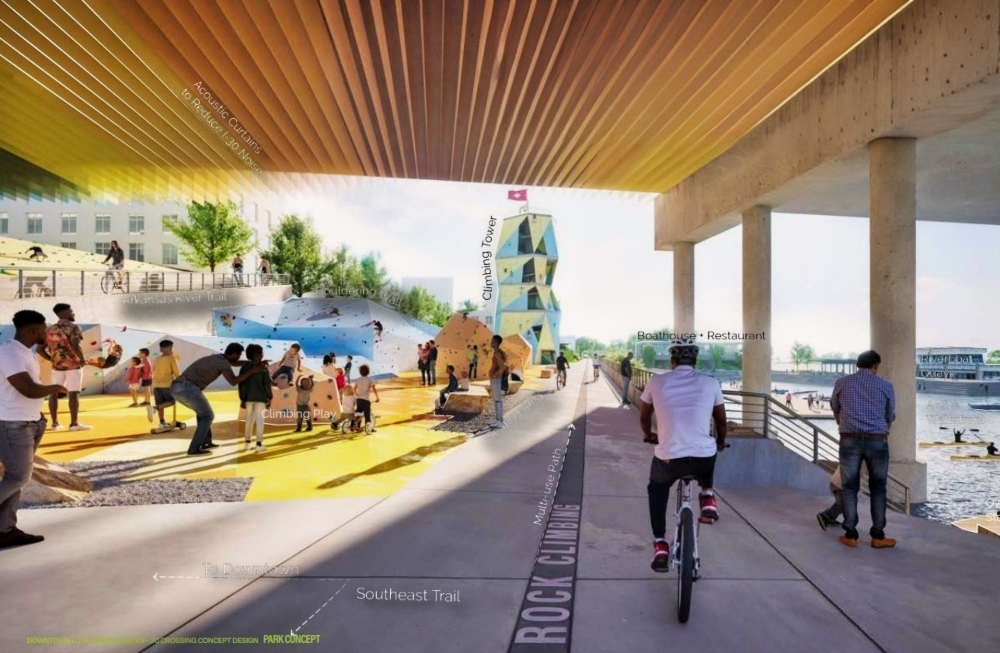
The master plan, developed by Sasaki, envisions a network of lawns, event spaces, playgrounds, recreation areas, trails, public art, water features, and restored natural landscapes that connect the River Market District, MacArthur Park, the Clinton Presidential Center, surrounding neighborhoods, and the Arkansas River Trail. The design also incorporates stormwater management features and native plantings that improve environmental resilience while creating a signature civic space.
Construction will occur in phases over several years, with early work expected to focus on infrastructure, grading, and public access improvements. Previous planning estimates placed the total project cost between approximately $93 million and $128 million, making the Bezos Earth Fund grant a significant step toward realizing the park’s long-term vision.
Big Vision, Big Questions
While Tuesday’s announcement was met with enthusiasm, it also raises important questions about what comes next.
The $30 million grant represents a major milestone, but it does not fully fund the ambitious vision outlined in the 30 Crossing Park master plan. Earlier estimates placed the total cost of the project between approximately $93 million and $128 million, leaving tens of millions of dollars still to be secured.
City leaders have said construction will occur in phases, but details about how the remaining funding will be assembled have yet to be announced. Additional public and private investment will likely be necessary before the park reaches its full buildout.
Long-term operations also remain an open question.
A 23-acre destination park featuring event spaces, landscaped gardens, playgrounds, trails, lighting, public art, and water features will require ongoing maintenance and programming. Whether those costs will be covered through the city’s Parks and Recreation budget, a public-private conservancy, sponsorships, event revenue, or another funding model has not yet been detailed.
The announcement also comes as Little Rock continues to work through a number of other significant parks and trail projects.
Less than a mile from Tuesday’s announcement stands one of Central Arkansas’s most significant unfinished trail projects, the gap in the Arkansas River Trail. Completing that connection, and a few other spots, would finally create a continuous off-street loop around the Arkansas River while improving bicycle and pedestrian access between downtown Little Rock and North Little Rock. It would also provide a direct connection to the future 30 Crossing Park.
Other long-awaited projects remain unfinished as well, including the Tri-Creeks Greenway in west Little Rock, and future trail links connecting the Arkansas River Trail to the developing Southwest Trail. Together, these projects form key pieces of the region’s active transportation and recreation network and have been priorities for advocates and local governments for years.
The announcement of the Bezos Earth Fund grant does not necessarily affect those efforts, but it does raise questions about how the city will prioritize future investments and whether momentum generated by the 30 Crossing Park project can also help advance other long-planned trail and park improvements across Little Rock.
Ultimately, Tuesday’s celebration marked the beginning of a new chapter rather than its conclusion. The grant provides a significant boost toward realizing one of the city’s most ambitious public space projects, but the conversations about funding, long-term stewardship, and how 30 Crossing Park fits into the broader vision for Little Rock’s parks and trail network are only beginning.
A Rare Partnership
Throughout the morning, speakers repeatedly highlighted the unusual level of cooperation that brought the project to this point.
Mayor Frank Scott Jr. closed the event by noting that success came from years of planning rather than chance.
“We’re here because of preparation,” Scott said. “Because of teamwork.”
He pointed to collaboration among the City of Little Rock, the Governor’s Office, ARDOT, Arkansas’s congressional delegation, business leaders, and community organizations as the foundation for securing the nationally competitive grant.
“We are grateful for this $30 million investment,” Scott said. “It is a tremendous opportunity that will help transform our city and shape its future. Now let’s get it done.”
For outdoor enthusiasts, cyclists, walkers, runners, and families, the announcement represents more than another park project. It signals a continued investment in creating connected, accessible public spaces that encourage active lifestyles while reshaping how residents and visitors experience downtown Little Rock. If the vision becomes reality, 30 Crossing Park could become one of Arkansas’s defining urban outdoor destinations while also serving as a catalyst for completing the broader network of parks and trails that residents have envisioned for decades.
More images and plan details are available on the master plan page.
You can watch the entire presentation here:
This article was originally published on ArkansasOutside.com, your trusted source for outdoor news and updates in The Natural State. Unless otherwise credited, all photos included in this piece are the property of Arkansas Outside, LLC. We take pride in sharing the beauty and adventures of Arkansas through our lens—thank you for supporting our work!