
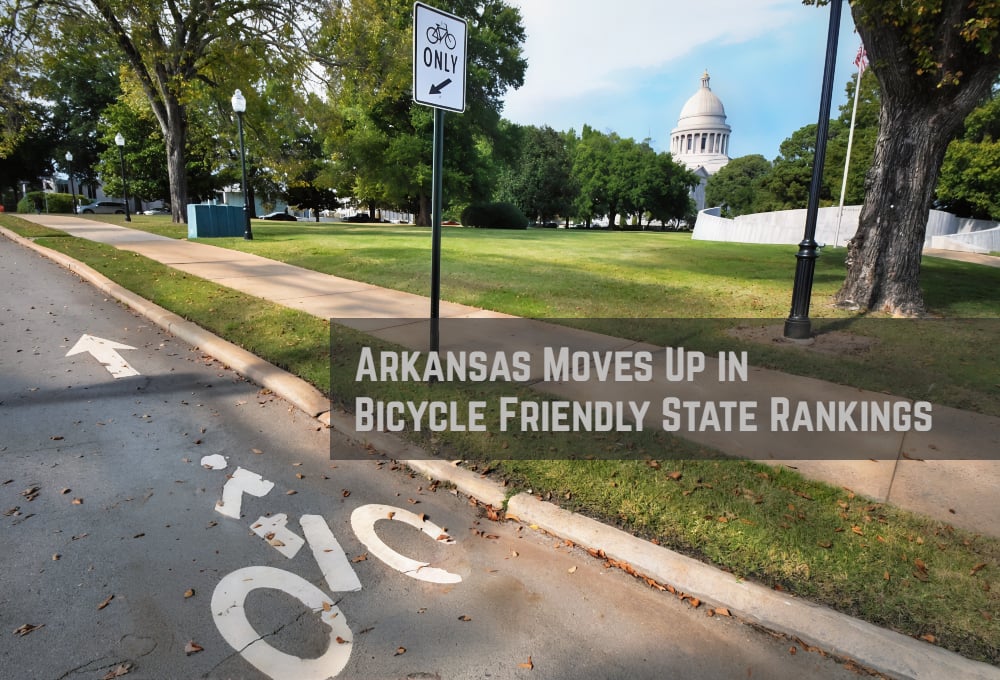

Arkansas climbs to 35th nationally in 2026, thanks in part to increased spending on bicycle infrastructure. But despite our reputation for great cycling, the state still struggles to make everyday bicycling safe.
Estimated reading time: 8 minutes
Arkansas has become a pretty incredible place to ride a bicycle. We’ve got world-class mountain bike trails, hundreds of miles of gravel roads, growing greenway systems and cycling events that attract visitors from across the country. From Bentonville to Hot Springs and the Arkansas Delta, there’s no shortage of places to enjoy a ride.
So it might surprise you to learn that Arkansas is still considered one of the less bicycle-friendly states in the country.
According to the League of American Bicyclists’ newly released 2026 Bicycle Friendly State Rankings, Arkansas ranks 35th out of 50 states. That’s actually good news, considering we were ranked 39th just two years ago.
We’re moving in the right direction, but there’s still a pretty big hill ahead.
The important thing to understand is that these rankings aren’t about how many miles of mountain bike trails we have or how many cyclists show up for a gravel race. They’re about how well a state accommodates people who use bicycles for everyday transportation. Can you safely ride to work? Can your kids ride to school? Is there a comfortable way to bicycle to the grocery store or visit a friend across town?
For many Arkansans, the answer is still no.
A Little History, and a Lot of Pedaling in Place
Arkansas has been struggling with these rankings for nearly two decades.
When the League began ranking states in 2008, Arkansas came in 39th. Things went downhill from there, reaching an embarrassing last-place finish in 2012.
That got the attention of state leaders.
Morrell Harriman, then chief of staff to Gov. Mike Beebe and an avid cyclist, brought together representatives from several state agencies to figure out how to improve things. The result was better bicycle safety education, updated law enforcement training and work toward a new statewide bicycle and pedestrian plan.
By 2013, Arkansas had climbed to 37th.
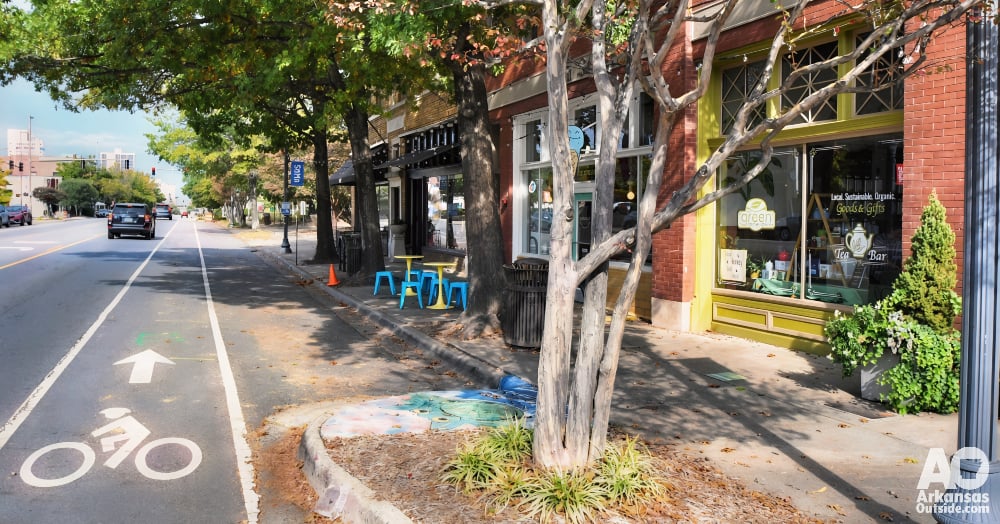
Another push came in 2017 when Gov. Asa Hutchinson established the Governor’s Advisory Council on Cycling. The group brought together cycling advocates and state agencies to work on laws and policies that would make bicycling safer.
Among the successes was the Arkansas Stop Law, passed in 2019, which allows cyclists to treat stop signs as yield signs under certain conditions. Other legislation addressed bicycles in crosswalks and bike racks on vehicles.
That same year, Arkansas reached its highest ranking ever, 32nd.
Unfortunately, the momentum didn’t last. The Governor’s Advisory Council on Cycling stopped meeting in 2022, and by 2024, Arkansas was back down to 39th, exactly where we started in 2008.
Now, in 2026, we’ve climbed back to 35th.
It’s progress, but history shows that Arkansas tends to improve when state leaders make bicycling a priority and lose ground when that attention fades.
The Good News: We’re Finally Spending More on Bicycling
One of the brightest spots in the 2026 report is how much Arkansas has increased spending on bicycle and pedestrian improvements.
In 2024, Arkansas spent $4.02 per person in federal transportation funds on bicycling and walking projects. That placed us 16th nationally.
In the new report, that number has jumped to $8.73 per person, putting Arkansas fifth in the nation for this type of spending.
That’s more than double the previous amount.
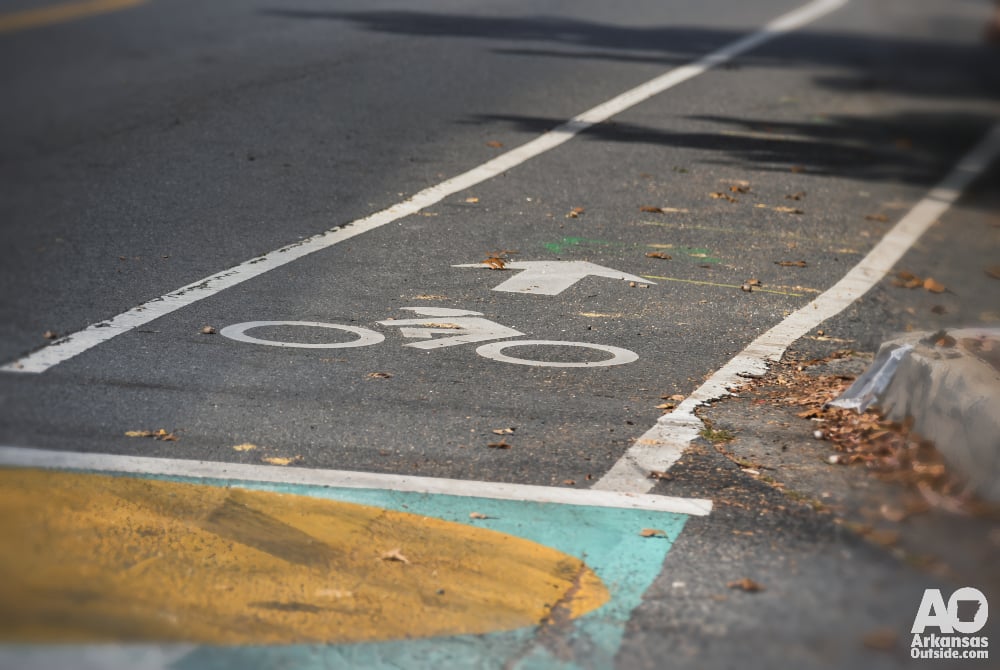
The League specifically praised Arkansas for increasing its investment in bicycle and pedestrian infrastructure.
One example is a $25 million federal grant awarded in 2025 for a shared-use trail along Highway 112 between Bentonville and Fayetteville. The project will help create a safer connection for people traveling between communities without a car.
These are the kinds of investments that can make a real difference, particularly when they connect neighborhoods, schools, businesses and existing trails.
It’s also an improvement that was specifically recommended in the state’s 2024 report card.
The Bad News: Our Roads Are Still Dangerous
Unfortunately, Arkansas’ bicycle safety numbers are nowhere near as encouraging.
The state ranks 45th nationally for bicycle safety, one of its worst scores in the report.
Perhaps the most troubling statistic is that more than 70% of bicyclist fatalities in Arkansas between 2020 and 2024 occurred on roads owned by the Arkansas Department of Transportation.
That’s a problem because many of those roads are the primary connections between our communities. They’re the roads people must use to reach schools, jobs, stores and other destinations.
Think about the roads you drive every day. How many have wide shoulders, protected bicycle lanes or safe crossings? How many would you feel comfortable riding on with your family?
For many Arkansans, riding a bicycle on a busy road isn’t something they would even consider.
And that brings us to another telling statistic.
Only 0.2% of Arkansas commuters ride bicycles to work, placing the state 45th nationally.
Of course, not everyone lives close enough to work to commute by bicycle, and Arkansas has plenty of rural communities where distances make bicycle transportation difficult. But even in our cities, safe and connected bicycle routes can be hard to find.
The League also recommends that Arkansas do more to accommodate bicyclists and pedestrians when bridges are built or rebuilt. After all, a perfectly good bicycle route doesn’t do much good if the only bridge across a river or highway is unsafe to cross.
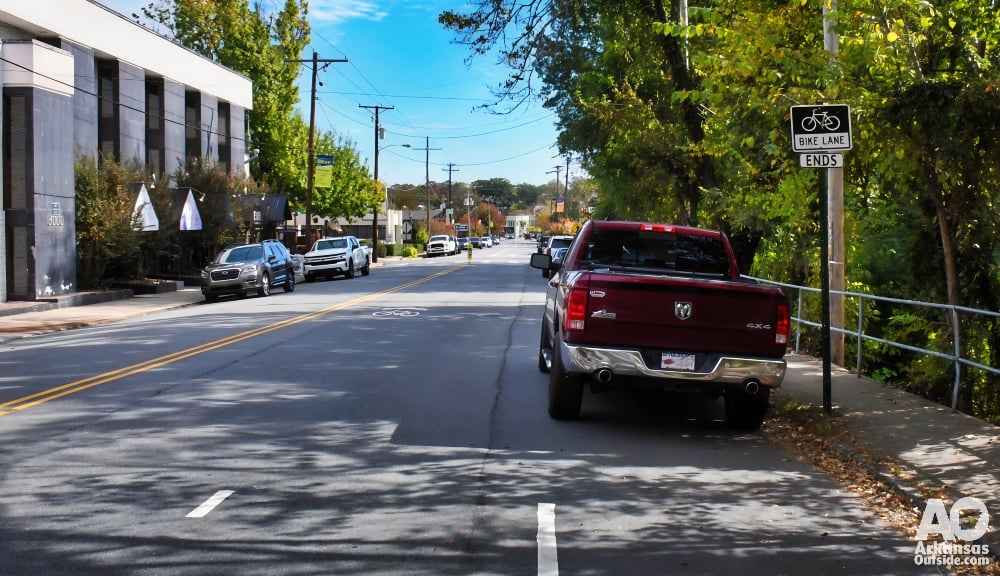
Great Trails Don’t Always Mean Great Bicycle Transportation
Here’s where Arkansas’ reputation as a cycling destination can be a little misleading.
We’ve invested heavily in recreational cycling, and it’s paying off. Northwest Arkansas has become an international mountain biking destination. Hot Springs continues to expand its trail offerings. Central Arkansas has seen significant growth in mountain bike trails, greenways and other recreational opportunities.
These are wonderful accomplishments, and they’re good for tourism, local businesses and quality of life.
But a great mountain bike trail doesn’t necessarily help someone trying to ride a bicycle to work.
The League’s rankings look at the bigger picture. Are our roads safe? Do communities have connected bicycle routes? Are state transportation agencies considering bicyclists when they design roads and bridges?
Arkansas still has work to do.
The 2026 report identifies eight Bicycle Friendly Communities in Arkansas, home to nearly 38% of the state’s population. That’s encouraging, but it also means much of the state remains outside communities recognized for their bicycle-friendly efforts.
What Would Make Arkansas More Bicycle-Friendly?
The good news is that improving our ranking doesn’t require reinventing the wheel.
The League has repeatedly identified several things Arkansas could do to make bicycling safer and more practical.
One is adopting a statewide Complete Streets policy. That may sound like government jargon, but the idea is simple: When we build or rebuild roads, we should consider everyone who uses them, not just people driving cars.
That means considering sidewalks, bicycle facilities, safe crossings and access for people with disabilities as part of normal road planning.
Some Arkansas cities, including Little Rock, already have local Complete Streets policies. However, Arkansas remains one of just 14 states without a statewide policy addressing transportation for all users.
Another recommendation is updating the state’s bicycle and pedestrian plan, which was last completed in 2017.
The League also wants Arkansas to improve safety on state highways, address vehicle speeds in populated areas and make bridges safer for people walking and bicycling.
These aren’t particularly radical ideas. They’re things many other states have already incorporated into their transportation systems.
There is some encouraging progress on another front. The new report recognizes Arkansas Moves and the Arkansas Active Transportation Coalition as statewide advocacy organizations, providing additional voices for safer bicycle transportation.
Where Do We Go From Here?
Arkansas’ climb from 39th to 35th is worth celebrating. Increased spending on bicycle and pedestrian projects is a significant step forward, and it shows that improvements are possible.
But we’ve been here before.
In 2012, a last-place ranking prompted state leaders to take action. In 2017, the creation of the Governor’s Advisory Council on Cycling helped renew that effort. Both times, Arkansas improved.
The challenge has always been keeping that momentum going.
We know how to build outstanding recreational trails. We know how to attract cyclists from around the world. We’ve even demonstrated that we can improve bicycle laws and transportation policies when we make them a priority.
Now we need to apply some of that same enthusiasm to the roads we use every day.
Imagine being able to ride from your neighborhood to a local restaurant without worrying about traffic. Imagine children safely bicycling to school or someone choosing to ride to work because there’s a comfortable, connected route.
That’s what being a Bicycle Friendly State is really about.
Arkansas has spent years becoming a great place to visit with a bicycle.
It’s time we put the same effort into making it a great place to live with one.
The League of American Bicyclists evaluates all 50 states through its Bicycle Friendly State program, examining bicycle safety, infrastructure, funding, laws and transportation policies. Arkansas ranked 35th nationally and eighth among 13 Southern states in the 2026 report.
This article was originally published on ArkansasOutside.com, your trusted source for outdoor news and updates in The Natural State. Unless otherwise credited, all photos included in this piece are the property of Arkansas Outside, LLC. We take pride in sharing the beauty and adventures of Arkansas through our lens, thank you for supporting our work!