

(Editors note: We don’t generally post articles on weekends–we like to play. But, we thought we might experiment with running an opinion piece on the weekends. We hope that the piece will create discussion around other recent articles. Feel free to join in the conversation in the comments below.)
Estimated reading time: 13 minutes
Opinion | By Joe Jacobs, Arkansas Outside
Arkansas has become a pretty remarkable place to ride a bicycle. We’ve built world-class mountain bike trails, developed scenic greenways, and created recreational opportunities that would have been difficult to imagine just 20 years ago. Communities across the state have discovered that investing in trails can attract visitors, support local businesses, and improve quality of life.
That’s all good news, and it’s something we should celebrate.
But there’s another side to bicycle infrastructure that doesn’t always get the same attention. While we’ve become pretty good at building places for people to ride bicycles for fun, we still struggle with building places where people can safely ride bicycles to get somewhere.
And there’s a difference.
Riding for Fun vs. Riding to Get Somewhere
I’ve spent a good portion of my life involved in outdoor recreation and bicycle advocacy, and I’ve seen firsthand how differently people view bicycle infrastructure depending on how they use it.
For a mountain biker, a successful trail might mean a challenging climb, an exciting descent, or a beautiful ride through the woods. For someone riding the Arkansas River Trail on a Sunday afternoon, success might simply mean enjoying a few hours outside without worrying about automobile traffic.
Those are worthwhile experiences. Recreational trails improve physical and mental health, create opportunities for families, and bring tourism dollars into Arkansas communities.
But consider someone who wants to ride a bicycle to work, school, or the grocery store.
That person has a different set of needs. They aren’t necessarily looking for a scenic route or a challenging ride. They need a reasonably direct, safe, and connected way to reach their destination.
A recreational trail can be successful even if it begins and ends at the same trailhead. A transportation route needs to connect places people actually want or need to go.
That distinction is important, particularly when communities begin talking about bicycle infrastructure investments.
The Missing Connections
The Arkansas River Trail is a good example of how recreation and transportation can overlap.
It’s one of central Arkansas’ most popular recreational assets, attracting walkers, runners, cyclists, and visitors. But portions of the trail also serve as valuable transportation corridors.
The problem is what happens when someone needs to leave the trail.
Can they safely reach a nearby business? Is there a comfortable route into the surrounding neighborhood? Can someone riding from home reach the trail without having to navigate a busy street with little or no bicycle infrastructure?
Too often, the answer is no.
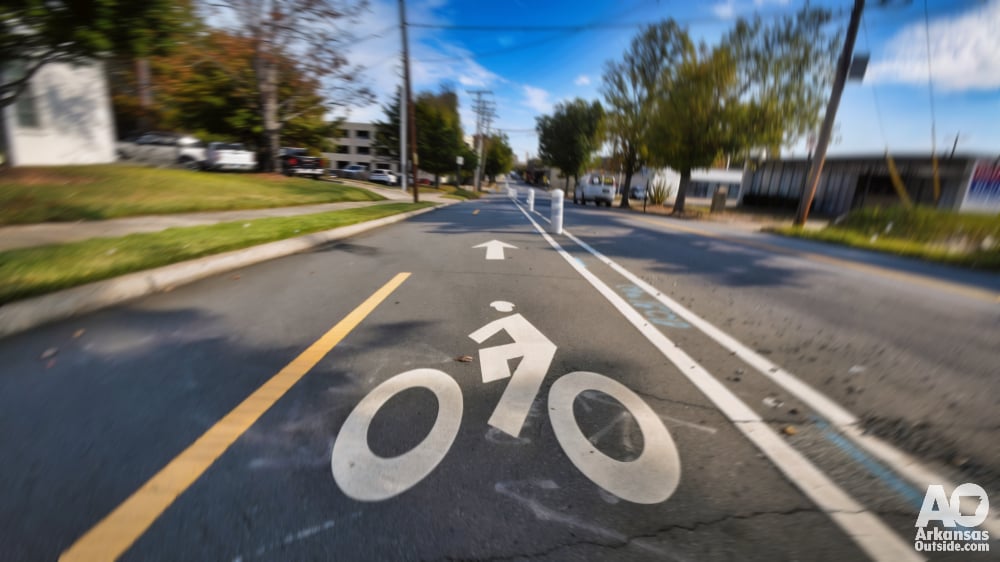
We have stretches of excellent trails that are disconnected from the neighborhoods and destinations around them. We also have bicycle lanes that appear for a few blocks before disappearing, leaving riders to figure out the next part of their trip on their own.
For recreational riders, these gaps can be inconvenient. For someone depending on a bicycle for transportation, they can make an otherwise reasonable trip impractical or dangerous.
A bicycle network is only as useful as its connections.
Complete Streets: Why Are We Building Bike Lanes a Few Blocks at a Time?
If you’ve driven down Napa Valley Drive or Seventh Street in Little Rock recently, you may have noticed something that seems a little odd. There are new bicycle lanes, but they only go so far before ending. You might wonder why the city would spend money building a bicycle lane that doesn’t seem to connect to much of anything.
The answer has a lot to do with Little Rock’s Complete Streets Ordinance.
Adopted in 2015, the ordinance established a policy that streets should be designed to accommodate everyone, not just motorists. That includes people walking, riding bicycles, using public transportation, and those with disabilities. It doesn’t mean every street must have a bicycle lane. It means that when streets are built, reconstructed, or resurfaced, the city must consider how the project can safely accommodate different types of users.
Here’s where things get interesting.
Little Rock doesn’t typically tear up perfectly good streets just to install bicycle lanes. Instead, much of the city’s bicycle infrastructure is added when a street is already scheduled for resurfacing or reconstruction. Once the old pavement markings are removed, the city has an opportunity to rethink how that street is laid out. Sometimes that means adding bicycle lanes, narrowing automobile lanes, improving crossings, or making other changes.
This approach can save money by incorporating bicycle improvements into work that’s already being done. The downside is that streets aren’t necessarily resurfaced in the order needed to create a connected bicycle network.
That’s how we end up with short stretches of bicycle infrastructure that seem to begin and end in the middle of nowhere.
Consider Napa Valley Drive, where the city completed approximately 3,000 linear feet of buffered bicycle lanes in 2024. Or Seventh Street, where approximately 2,700 feet of protected two-way bicycle infrastructure was completed in 2022. Both projects added bicycle facilities, but neither represents the completion of an entire transportation corridor.
Seventh Street is particularly interesting because the city’s long-range bicycle plans identify it as an important east-west connection through downtown and a potential link to the Central Arkansas Regional Greenway and Southwest Trail. The existing section is intended to become part of something much larger.
In theory, this incremental approach makes sense. Each time a street is improved, another piece of the bicycle network falls into place. Eventually, those pieces should connect.
But there’s a catch. A collection of bicycle lanes isn’t necessarily a bicycle transportation network.
Someone trying to ride to work or the grocery store doesn’t benefit nearly as much from a bicycle lane that ends at a busy intersection with no safe way to continue. And a parent isn’t likely to let their child ride to school simply because a few blocks of the route have bicycle lanes.
The city’s own bicycle planning materials acknowledge that disconnected facilities do little to encourage ridership. Connectivity is what makes the system useful.
I support Little Rock’s Complete Streets Ordinance. It’s an important policy that helps ensure we’re considering more than automobile traffic when we invest in our streets. But we also need to recognize its limitations.
Building bicycle infrastructure as opportunities arise is a practical way to stretch limited transportation dollars. However, it shouldn’t be our only strategy. We also need dedicated projects that deliberately connect those scattered pieces, particularly where dangerous intersections or missing links discourage people from walking or riding.
The ordinance provides a framework for building better streets over time. The challenge now is making sure those individual improvements eventually become a network people can actually use.
And that brings us right back to the difference between recreational cycling and transportation cycling. A few disconnected blocks might be a small inconvenience on a recreational ride. For someone depending on a bicycle to get to work, those missing connections can make all the difference.
Don’t Forget the People Walking
One thing that sometimes gets lost in bicycle infrastructure discussions is how much of this work also benefits pedestrians.
Not everyone wants to ride a bicycle, and not everyone can. But nearly everyone benefits from safer streets, better sidewalks, accessible crossings, and reduced traffic speeds.
Think about someone walking to a bus stop, a parent pushing a stroller, a person using a wheelchair, or an older resident trying to cross a busy street.
Their needs aren’t all that different from those of someone riding a bicycle for transportation. They need safe, predictable, connected routes.
Of course, pedestrians and cyclists don’t always need exactly the same facilities. A narrow sidewalk isn’t a substitute for a bicycle lane, and a crowded shared-use path isn’t always the best place for faster bicycle traffic. Good design recognizes those differences rather than forcing everyone into the same limited space.
That’s why I believe bicycle advocacy needs to be part of a larger conversation about active transportation, accessibility, and how we design our communities.
We’re not simply advocating for more places to ride bicycles. We’re advocating for communities where people can move around safely without always having to get into a car.
We Need Recreational Cyclists in the Conversation
Something I’ve noticed over the years is that recreational cyclists and transportation cyclists don’t always see themselves as part of the same movement.
A mountain biker might be passionate about protecting trail access but have little interest in bicycle lanes. A road cyclist might focus on safer rural highways. A transportation cyclist might be primarily concerned with intersections, neighborhood connectivity, and getting to work.
Those priorities are different, but they aren’t competing interests.
In fact, they have quite a bit in common.
All of these groups benefit from communities that recognize bicycling as a legitimate activity deserving of safe, thoughtfully designed infrastructure.
And all of them have something to contribute to the conversation.
Recreational cycling has helped demonstrate the economic value of bicycle infrastructure in Arkansas. Mountain bike destinations such as Bentonville, Hot Springs, and the Monument Trails have shown communities that trails can be significant assets.
That success gives bicycle advocates an opportunity.
If we can convince communities to invest in trails because they attract tourists and improve quality of life, we should also be able to make the case for infrastructure that helps residents safely reach their jobs, schools, parks, and businesses.
The economic argument doesn’t disappear when someone uses a bicycle for transportation. People who walk and ride bicycles shop at local businesses, support neighborhood economies, and contribute to healthier, more attractive communities.
There’s another benefit to better active transportation infrastructure that recreational cyclists should appreciate: the ability to ride to the ride. Imagine being able to leave your house on a bicycle, safely navigate neighborhood streets and connected bike paths, and arrive at your favorite paved greenway or natural-surface trail without ever loading a bike onto a car. No bike rack required, no searching for a parking space at a crowded trailhead, and no burning gas just to get somewhere to ride. For mountain bikers, that could mean connecting neighborhoods directly to trail systems. For road cyclists and families, it could mean safely reaching a greenway without having to drive across town. Better connections also reduce the need for expensive trailhead parking lots, leaving more resources available for trails and other improvements. The ride to the trail becomes part of the adventure, and recreational cycling becomes more accessible to people who don’t own a vehicle or have a way to transport their bicycles. That’s a pretty good argument for recreational cyclists to support transportation infrastructure, even if they never plan to commute to work by bicycle.
We need to make sure those benefits are part of the discussion.
For Some People, It’s Not a Choice
There’s another important distinction that deserves more attention.
For many of us, riding a bicycle is something we choose to do. We ride for exercise, recreation, competition, or simply because we enjoy it.
But not everyone riding a bicycle or walking along a busy road is doing so by choice.
Some people don’t own cars. Others can’t drive because of age, disability, or financial circumstances. For them, walking, bicycling, and public transportation are essential parts of everyday life.
When we fail to provide safe infrastructure, we’re not just making recreation less convenient. We’re making it harder for people to get to work, buy groceries, attend school, or access medical care.
That’s a much bigger issue than whether a community has enough bike lanes.
It’s about access and opportunity.
Arkansas Has an Opportunity, and the Rankings Tell the Story
Earlier this week, Arkansas Outside reported on the League of American Bicyclists’ newly released 2026 Bicycle Friendly State Rankings. Arkansas moved up from 39th in 2024 to 35th this year. That’s progress, but it also raises an interesting question.
How can a state with some of the best mountain biking and recreational cycling opportunities in the country still rank in the bottom third for bicycle friendliness?
The answer gets right to the heart of the difference between recreational cycling and transportation cycling.
As we explained in our article, Arkansas Moves Up in Bicycle Friendly State Rankings, but There’s Still a Long Road Ahead, the League looks beyond recreational trails. It evaluates bicycle safety, infrastructure, funding, laws, and transportation policies. In other words, it’s not just asking whether Arkansas is a great place to ride a bicycle. It’s asking whether Arkansas is a safe and practical place to use one.
Closing the loop on the Arkansas River Trail is an important goal, and one worth continuing to pursue. But completing that connection alone isn’t going to dramatically improve Arkansas’ standing in the League of American Bicyclists’ Bicycle Friendly State Rankings. That will require a much broader commitment to safe streets, connected neighborhoods, bicycle-friendly policies, and infrastructure that makes everyday transportation by bicycle a realistic option.
Some of the numbers are revealing.
Arkansas ranks 45th nationally for bicycle safety, and only 0.2% of the state’s commuters ride bicycles to work. Meanwhile, the state has increased federal transportation spending on bicycle and pedestrian projects to $8.73 per person, ranking fifth nationally for that measure.
So we’re investing more, but we still have a long way to go.
These rankings don’t diminish what Arkansas has accomplished with recreational trails. They simply demonstrate that being a great cycling destination and being a bicycle-friendly state aren’t necessarily the same thing.
The League’s recommendations also reinforce why bicycle and pedestrian advocates need to work together. A statewide Complete Streets policy, safer intersections, better accommodations on bridges, and more connected transportation networks would benefit people walking, bicycling, and using mobility devices.
We’ve proven that Arkansas can build outstanding places to ride for recreation. Now we need to put that same energy into creating safe routes for everyday transportation.
And that’s where recreational cyclists can make a real difference. The enthusiasm, community support, and political influence that helped build our recreational trail systems could be equally valuable in advocating for safer streets and better connections.
We shouldn’t have to choose between building great places to ride on weekends and building safe ways to get around during the week.
We can, and should, do both.
A Bigger Tent for Advocacy
I believe one of the most important things we can do as bicycle advocates is broaden our perspective.
If you’re a mountain biker, support efforts to create safer streets. If you’re a bicycle commuter, recognize the value of recreational trails. If you’re a road cyclist, understand that protected bicycle infrastructure can help people who aren’t comfortable sharing a busy road with automobiles.
And regardless of how you ride, support improvements that make walking safer and more accessible.
We don’t all have to use the same infrastructure or ride for the same reasons to recognize its value.
In fact, the more people we bring into the conversation, the stronger our advocacy becomes.
Imagine what could happen if recreational cyclists, transportation cyclists, pedestrians, accessibility advocates, public transit supporters, and neighborhood organizations consistently worked together toward safer, more connected communities.
That’s a much broader and more effective coalition than any one group can build on its own.
It’s About Having Choices
I don’t expect everyone to start commuting by bicycle. I don’t expect every street to have a protected bike lane, and I certainly don’t expect everyone to give up their cars.
That’s not the point.
The point is that people should have reasonable choices.
Someone should be able to ride a bicycle to a neighborhood restaurant without feeling like they’re taking their life into their hands. A child should have a safe way to walk or ride to school. An older resident should be able to cross a street without having to sprint between traffic signals.
And someone who simply wants to enjoy a Saturday morning ride should have great places to do that, too.
Arkansas has demonstrated that it knows how to build outstanding recreational bicycle infrastructure. Now we need to put the same creativity, commitment, and long-term thinking into building transportation networks that serve the people who live here.
Because a truly bicycle-friendly community isn’t just a place where people come to ride. It’s a place where people can ride, walk, and move safely as part of everyday life.
That’s a goal worth advocating for, whether your favorite ride is a mountain bike trail, a country road, a greenway, or the trip to work.
2 Responses
Thank you for the eye-opening article. I have often wondered about the bike lanes to nowhere. I would very much like to see our inner city streets and our rural roads bike friendly. Apparently the county doesn’t have the rules of improvements since many roads have been repaved, such as hwy 10, without adding much need bike lanes.
I probably should have mentioned that the Complete Streets ordinance only applies to Little Rock city streets and not to county roads or state highways.