
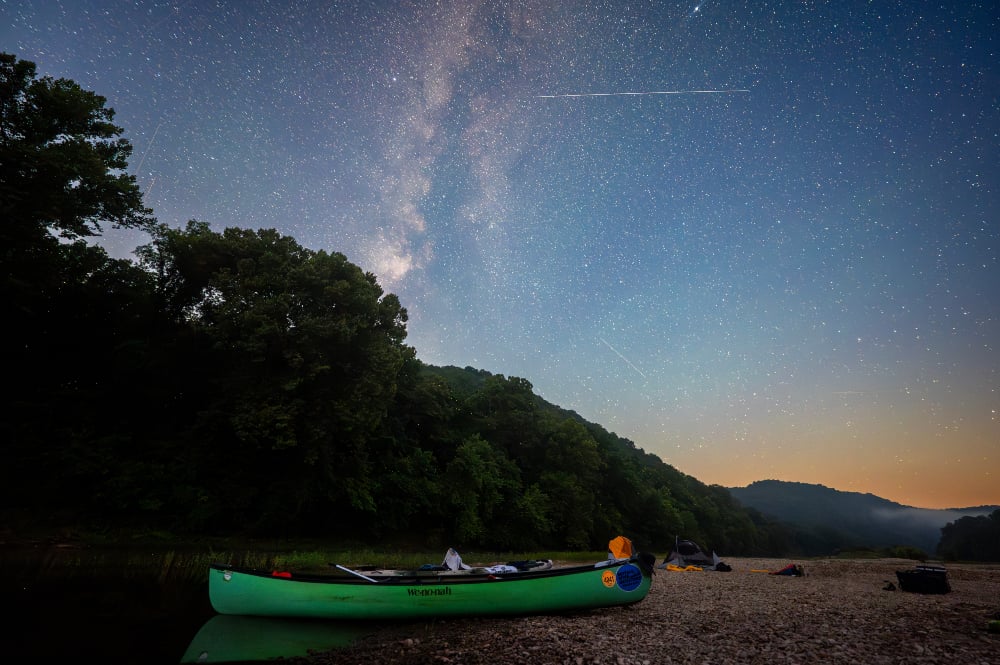

The clocks have changed, darkness is arriving before dinner, and Arkansas outdoor enthusiasts have a new reason to get outside. Just remember to look up.
Estimated reading time: 10 minutes
Well, here we are again. Daylight saving time has ended, the clocks have fallen back, and suddenly it feels like bedtime before we’ve even figured out what’s for dinner.
For those of us who enjoy spending time outdoors, the annual time change can be a little depressing. The after-work bike ride is now a race against the sunset, hiking requires a bit more planning, and by 6 p.m., we’re wondering whether it’s too early to put on pajamas.
But what if we’ve been looking at this whole early darkness thing the wrong way?
What if, instead of complaining about losing an hour of evening daylight, we started taking advantage of the extra darkness?
Welcome to the world of dark-sky tourism, where the best views don’t appear until the sun goes down, the equipment can be as simple as a lawn chair, and Arkansas has some of the best seats in the house.
The Natural State Has a Pretty Good Nightlife
We’re not talking about bars, restaurants or live music. We’re talking about the original nighttime entertainment, the stars.
Dark-sky tourism, sometimes called astrotourism, is gaining attention as more people discover the pleasure of escaping city lights to experience the night sky as nature intended.
For those who have spent most of their lives in cities or suburbs, seeing the Milky Way stretch across the sky can be a revelation. It’s the kind of sight that makes you stop talking, lean back and realize just how much you’ve been missing.
And Arkansas is particularly well-suited for it.
Our national forests, remote state parks, mountain ridges and river valleys provide plenty of places where artificial light hasn’t completely overwhelmed the nighttime landscape.
The best part? Unlike most outdoor adventures, you don’t have to get up at 5 a.m. to enjoy this one. In fact, with the recent time change, you can have dinner, head outside and still be home at a reasonable hour.
Of course, once you see a truly dark sky, you might decide to stay out a little longer.
The Buffalo National River: Arkansas’s Star Attraction
If Arkansas has a capital of stargazing, it would probably be somewhere along the Buffalo National River.
In 2019, the Buffalo became Arkansas’s first certified International Dark Sky Park, a designation awarded by DarkSky International to places that protect exceptional nighttime environments through responsible lighting and public education.
Most of us already know the Buffalo for its towering bluffs, clear water, hiking trails and campgrounds. But after sunset, the river corridor offers another spectacular attraction.
On a clear, moonless night, thousands of stars fill the sky. The Milky Way can appear as a hazy band of light stretching overhead, and familiar landscapes take on an entirely different personality.
Nearby Gilbert, the small community along the Buffalo, has also embraced night-sky protection through efforts to encourage responsible outdoor lighting.
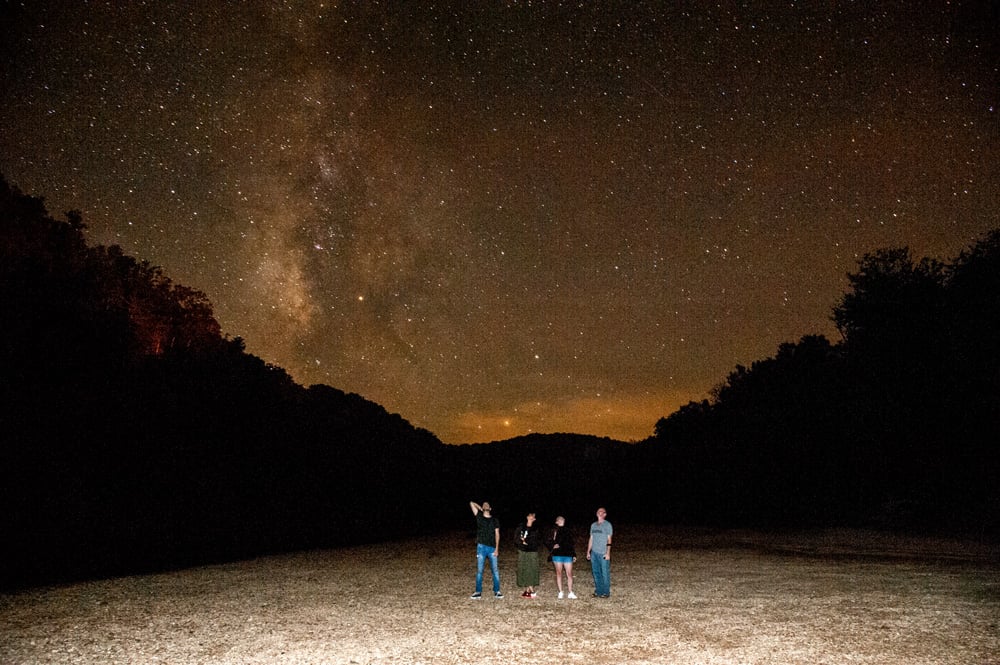
For communities that depend on outdoor tourism, the appeal is obvious. Visitors who come for the river during the day might stay another night for the stars.
And unlike building a new trail, visitor center or attraction, the stars are already there. We just need to avoid lighting them out of existence.
There’s More Than One Place to Get Starstruck
The Buffalo may have the official designation, but Arkansas has plenty of other places where the nighttime scenery deserves a little attention.
The Ouachita and Ozark mountains contain extensive areas of public land with relatively low levels of light pollution. The farther you get from cities and major highways, the better your chances of finding a sky filled with stars.
A few destinations worth considering include:
- Ouachita National Forest: Remote mountain ridges, recreation areas and forest clearings offer opportunities to escape urban lighting. Find an open view of the sky, and the stars can put on quite a show.
- Ozark-St. Francis National Forests: Away from towns and major roads, portions of these forests provide some of the darker nighttime environments in the state.
- Cossatot River State Park-Natural Area: Known for its rugged river scenery and challenging whitewater, the Cossatot also offers the potential for beautiful nightscape photography.
- Queen Wilhelmina State Park: Perched atop Rich Mountain, this state park offers mountain views that can be just as interesting after sunset, assuming the clouds and fog cooperate.
- Mount Magazine State Park: Arkansas’s highest point provides dramatic scenery for nighttime photography. Efforts to pursue International Dark Sky Park certification could make it an even more important destination for stargazers.
Not every location is officially designated as a dark-sky destination, and even remote areas can have nearby lighting that affects the view.
The Arkansas Natural Sky Association maintains maps of potential viewing locations, which can help take some of the guesswork out of finding a good spot.
One word of caution: Just because a place looks perfect on a map doesn’t mean it’s open after dark. Check park hours, campground access and local regulations before heading out.
Astrophotography: Because Your Phone Needs More Pictures of Stars
If you’ve ever pointed your phone toward a beautiful night sky, snapped a picture and ended up with what looks like a black rectangle containing three blurry dots, you’re not alone.
Photographing the stars can be a little more challenging than photographing your lunch.
But astrophotography, the art of capturing stars, planets, galaxies and other celestial objects, has become increasingly accessible to everyday outdoor enthusiasts.
Modern digital cameras and newer smartphones with night photography features can produce impressive results. Add a sturdy tripod, a little patience and some basic knowledge of long exposures, and you can begin capturing images that once required expensive equipment.
For Arkansas photographers, the real opportunity comes from combining the stars with familiar landscapes.
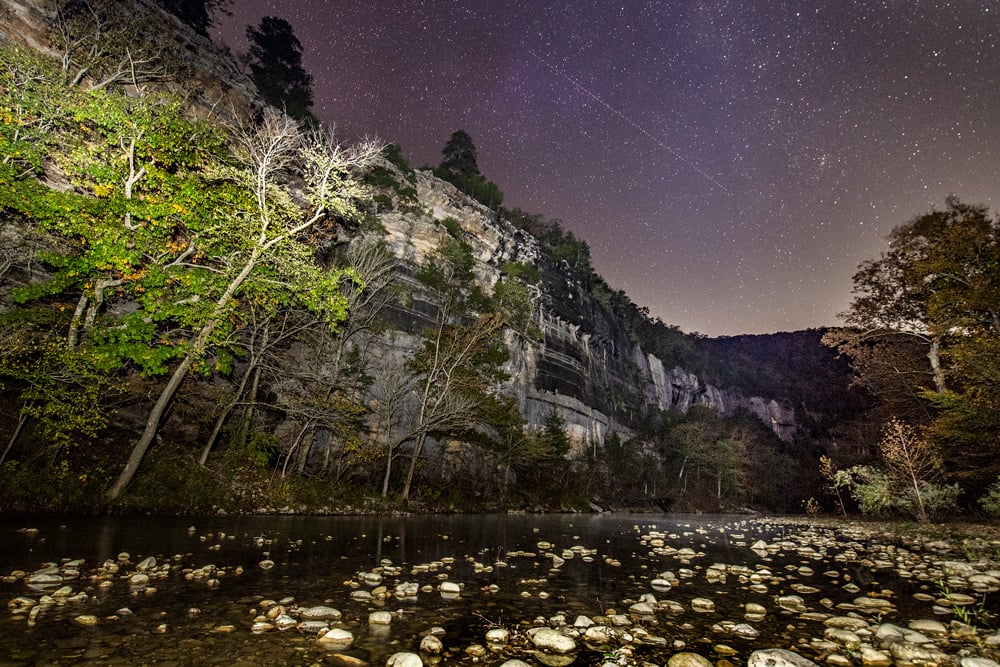
Imagine the Milky Way rising above the Buffalo River bluffs, a meteor streaking across the Ouachita Mountains or stars reflecting off the still waters of Lake Ouachita.
Those are the kinds of images that make people stop scrolling.
Of course, the universe doesn’t always cooperate with your photography schedule.
Clouds, humidity, haze, moonlight and nearby artificial lighting can all interfere. The brightest portion of the Milky Way is also seasonal, with some of the best opportunities to photograph its galactic center occurring during the warmer months.
That doesn’t mean winter is a bad time to photograph the stars. Orion, the Pleiades and other winter constellations provide excellent subjects, and longer nights give photographers more time to experiment.
You just might need a warmer jacket.
Arkansas Has People Who Know Their Way Around the Universe
Fortunately, you don’t have to figure all of this out on your own.
The Arkansas Natural Sky Association is helping lead efforts to protect the state’s nighttime environment while introducing more people to astronomy and responsible outdoor lighting.
The organization, affiliated with DarkSky International, maintains a Natural Sky Places Map identifying potential viewing locations and a Natural Sky Host Map highlighting accommodations that support responsible lighting practices.
That last part is particularly interesting for tourism.
Imagine booking a cabin specifically because the owners have taken steps to reduce unnecessary outdoor lighting and provide a good view of the stars.
It’s a different kind of amenity, one where less light is actually a selling point.
The association also encourages participation in programs such as Globe at Night, an international citizen science project that allows ordinary people to help researchers monitor light pollution.
Arkansas’s astronomical societies are another excellent resource.
The Central Arkansas Astronomical Society, which operates River Ridge Observatory near Bigelow, hosts observing opportunities and educational programs. Public star parties introduce visitors to telescopes, constellations and celestial objects that might otherwise go unnoticed.
The Sugar Creek Astronomical Society in Northwest Arkansas also helps connect people with astronomy through public outreach and observing events.
These gatherings are especially good for beginners. There’s usually someone willing to explain what you’re looking at, help you find a planet or answer the question everyone eventually asks: “Is that a star or a satellite?”
Saving the Night Is About More Than Seeing Stars
There’s also a serious conservation issue behind all this nighttime fun.
Light pollution has steadily expanded as communities grow, businesses develop and increasingly powerful outdoor lighting becomes commonplace.
Anyone who has driven through a rural area and suddenly encountered a gas station or commercial property illuminated like a professional football stadium knows what we’re talking about.
Much of that light is unnecessary.
Poorly designed outdoor lighting can spill upward into the sky, shine into neighboring properties and interfere with the natural nighttime environment.
It can also affect wildlife.
Migrating birds, bats, insects and other nocturnal animals depend on natural patterns of light and darkness. Artificial lighting can disrupt navigation, feeding, reproduction and other behaviors.
The good news is that protecting dark skies doesn’t mean turning off every light and stumbling around in the dark.
Responsible lighting generally means directing light where it’s needed, using appropriate brightness levels, choosing warmer-colored lighting and turning lights off when they’re no longer necessary.
In many cases, these practices can save energy and money while improving visibility.
For Arkansas communities interested in dark-sky tourism, protecting the resource now could be much easier than trying to restore it later.
Your Beginner’s Guide to Getting Lost in Space (Without Leaving Arkansas)
Ready to give stargazing a try? You don’t need a telescope, an astronomy degree or a spaceship. A little planning will do.
Pick a dark night. The best stargazing generally happens around the new moon, when moonlight isn’t washing out the fainter stars.
Get away from the lights. Even a short drive away from urban areas can make a difference. For the best experience, head toward one of Arkansas’s more remote public lands or designated observing locations.
Check the weather. Clouds are the obvious problem, but haze and humidity can also make the stars harder to see.
Bring a chair and dress warmly. A reclining camp chair is ideal. You’ll spend a lot of time looking up, and your neck will thank you. Arkansas nights can get surprisingly cold, especially when you’re sitting still.
Use a red-light flashlight. Bright white lights can ruin your night vision and annoy everyone around you. Give your eyes 20 to 30 minutes to adjust to the darkness.
Start simple. Learn to recognize a few constellations, watch for satellites or bring binoculars to explore the moon and brighter star clusters.
Leave the place better than you found it. Stay in approved access areas, respect campground quiet hours, avoid disturbing wildlife and pack out your trash.
And one more thing: Tell someone where you’re going. Wandering around an unfamiliar trailhead in complete darkness isn’t the kind of adventure we’re recommending.
Maybe the Time Change Isn’t So Bad After All
Every November, we complain about the clocks changing and the sun disappearing before we’ve finished our afternoon coffee.
We grumble about shorter days, pull out our headlamps and start counting the weeks until spring.
But perhaps there’s another way to look at it.
Arkansas has spent years developing its reputation as an outdoor recreation destination. We’ve built trails, improved river access, expanded camping opportunities and encouraged people to explore the Natural State.
Now, there’s an opportunity to introduce more people to an outdoor experience that has been here all along.
The stars don’t require a trail-building crew, a ribbon-cutting ceremony or a multimillion-dollar development project. They just need a little darkness.
So the next time you find yourself looking out the window at 6 p.m. and wondering why it feels like midnight, resist the urge to call it a day.
Grab a jacket, find a dark spot and look up.
It turns out that losing an hour of evening daylight might be just what we need to discover a whole new side of Arkansas.
Resources for Arkansas Stargazers
Arkansas Natural Sky Association: https://darkskyarkansas.org/
Arkansas Natural Sky Observation Sites: https://darkskyarkansas.org/stella-observation-sites/
Natural Sky Host Facilities: https://darkskyarkansas.org/stella-host-facilities/
Buffalo National River Night Sky Viewing: https://www.nps.gov/buff/planyourvisit/night-sky-viewing.htm
Central Arkansas Astronomical Society: https://www.caasastro.org/
Arkansas Dark-Sky Festival: https://darkskyarkansas.org/darkskyfestival/
Globe at Night: https://globeatnight.org/
This article was originally published on ArkansasOutside.com, your trusted source for outdoor news and updates in The Natural State. Unless otherwise credited, all photos included in this piece are the property of Arkansas Outside, LLC. We take pride in sharing the beauty and adventures of Arkansas through our lens, thank you for supporting our work!