
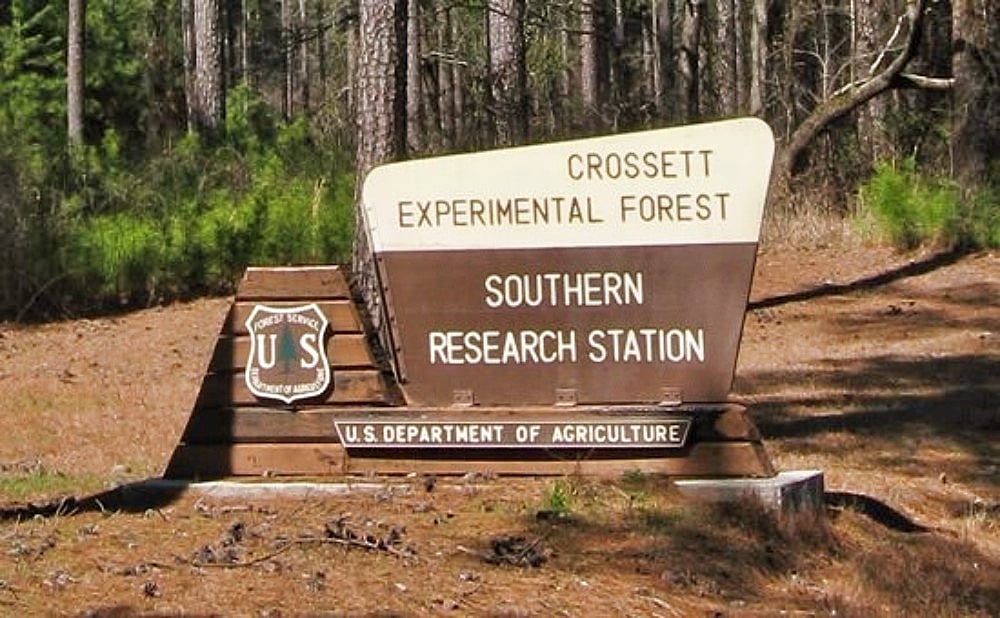

Westerman legislation seeks to preserve forestry research at Crossett Experimental Forest amid a nationwide restructuring of the U.S. Forest Service.
Estimated reading time: 6 minutes
A historic Arkansas forest that has helped shape forestry management practices for more than 90 years could soon be under state ownership.
On Nov. 17, the U.S. House of Representatives passed the Crossett Experimental Forest Act of 2026 (H.R. 10136), legislation introduced by Arkansas Congressman Bruce Westerman that would transfer ownership of the federally managed research forest in Ashley County to the state of Arkansas. The legislation must still clear the Senate and be signed into law.
The legislation comes amid a sweeping reorganization of the U.S. Forest Service that has raised concerns about the future of forestry research in Arkansas and across the country.
In April, Arkansas Outside reported on the planned closure of 57 of the Forest Service’s 77 research facilities nationwide, including the Southern Pine Ecology and Management Research Unit headquartered at the University of Arkansas at Monticello. That office has historically provided scientific support and oversight for research at Crossett.
The proposed transfer offers a potential path forward for one of Arkansas’ most significant forestry research sites, although questions remain about the future of other research facilities across the state.
Preserving More Than 90 Years of Forest Research
Established in 1934, the approximately 1,685-acre Crossett Experimental Forest has played an important role in developing sustainable forest management practices, particularly those involving loblolly and shortleaf pine forests.
Research conducted at Crossett has helped forestry professionals understand how to manage timber production while maintaining healthy forest ecosystems. Its long-term research has benefited scientists, private landowners, wildlife managers and the timber industry.
However, federal investment in the facility has declined over the years. According to a report from the House Committee on Natural Resources, Dr. Don Bragg was the only Forest Service scientist working at Crossett during the final 15 years of his career. Following his death in 2023, the Forest Service did not fill his position, and research activity declined significantly.
Westerman, who chairs the House Committee on Natural Resources and has a professional background in forestry, introduced the legislation on Aug. 20, 2026.
During remarks on the House floor, Westerman emphasized that Arkansas is prepared to commit resources to the property and work with the University of Arkansas at Monticello to revive its research programs.
The legislation passed with bipartisan support.
What the Transfer Would Mean
Under the legislation, Arkansas would have 180 days following enactment to formally request ownership of the property. The federal government would transfer the land without a purchase price, although Arkansas would be responsible for administrative and survey expenses.
The legislation includes several provisions:
- The property would be renamed the Crossett Experimental State Forest.
- The transfer would include the R.R. Reynolds Research Natural Area and associated facilities.
- Arkansas would be required to preserve the property’s historical scientific and educational mission.
- The state would coordinate research with the University of Arkansas at Monticello and the University of Arkansas Division of Agriculture.
- The federal government would provide Arkansas with copies of historical research records, scientific data and related documentation.
- The property could return to federal ownership if Arkansas fails to meet the management requirements and does not correct those deficiencies within the prescribed period.
What Will It Cost Arkansas Taxpayers?
While the federal government would transfer the Crossett Experimental Forest to Arkansas at no purchase price, the state would assume the costs of acquiring, maintaining, staffing and operating the research facility.
Westerman has indicated that Arkansas is prepared to dedicate resources to the forest, but no specific funding commitment, projected annual operating budget or staffing plan has been publicly identified. The legislation provides no dedicated federal funding for ongoing operations.
Questions remain about whether the Arkansas General Assembly will need to appropriate additional funding or whether existing state agency and university budgets will absorb the costs. While the transfer could preserve valuable forestry research, it also shifts a long-term financial responsibility from the federal government to Arkansas taxpayers.
What About Arkansas’ Other Experimental Forests?
While the legislation represents progress for Crossett, it does not address the broader concerns raised in our April report on Forest Service research station closures.
Three other experimental forests in Arkansas remain outside the scope of the legislation:
Sylamore Experimental Forest, Stone County: Supports research into upland hardwood forests in the Ozarks.
Henry R. Koen Experimental Forest, Newton County: Provides opportunities to study hardwood forest management and watershed conditions near the Buffalo National River.
Alum Creek Experimental Forest, Garland County: Supports forestry research in the Ouachita Mountains.
The legislation also does not reverse the planned closure of the Southern Pine Ecology and Management Research Unit’s federal office in Monticello.
Whether similar state and university partnerships could help preserve research at these other locations remains an open question.
Why Forest Research Matters to Outdoor Recreation
While experimental forests are primarily scientific facilities rather than outdoor recreation destinations, the research conducted within them has implications for nearly everyone who enjoys Arkansas’ public lands.
Forest management decisions influence wildlife habitat, wildfire risk, water quality, invasive species control, biodiversity and the health of the landscapes where Arkansans hike, mountain bike, camp, hunt and fish.
Long-term research is particularly valuable because forests change slowly. Understanding how ecosystems respond to drought, prescribed fire, timber harvesting, disease and changing weather patterns requires consistent observation over decades.
Preserving the land itself is only part of the equation. Maintaining the scientists, institutional knowledge, historical records and research partnerships that make these forests valuable is equally important.
A Potential Model for the Future?
If the legislation becomes law, Crossett could provide an example of how state governments and public universities can preserve scientific research as the federal government reduces its physical presence in local communities.
However, transferring ownership also shifts the responsibility for maintaining the property, staffing research programs and supporting scientific work to the state and its partners.
Whether Arkansas can provide the resources necessary to sustain that work over the long term will ultimately determine the success of the transfer.
For now, the House vote represents an encouraging development for one of Arkansas’ oldest experimental forests. The larger question of how the Natural State will preserve its forestry research infrastructure remains unresolved.
Arkansas Outside will continue to follow the legislation as it moves through Congress and monitor developments involving the state’s other experimental forests.
This article was originally published on ArkansasOutside.com, your trusted source for outdoor news and updates in The Natural State. Unless otherwise credited, all photos included in this piece are the property of Arkansas Outside, LLC. We take pride in sharing the beauty and adventures of Arkansas through our lens—thank you for supporting our work!