
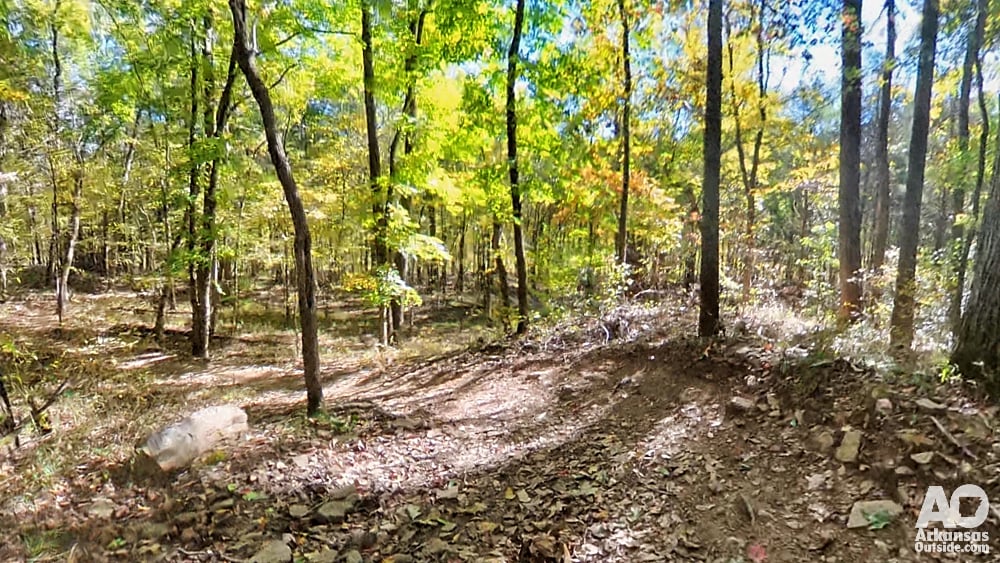

One of Arkansas’s original mountain biking destinations continues to challenge riders with rocky singletrack, creek crossings, punchy climbs, and a little piece of mountain biking history.
Estimated reading time: 8 minutes
Long before Arkansas became nationally recognized for its mountain biking trails, a small state park in the Boston Mountains was helping introduce riders to the sport. Today, the Fossil Flats Trail at Devil’s Den State Park remains a reminder of those early days, offering a challenging ride through the rugged terrain that helped establish Arkansas mountain biking.
I returned to Fossil Flats this weekend while attending a retirement celebration for Tim Scott, a longtime Arkansas State Parks employee whose contributions to mountain biking extend well beyond the boundaries of Devil’s Den. It seemed appropriate to revisit one of the trails closely connected to the sport’s early development in Arkansas.
Fossil Flats isn’t a modern, machine-built flow trail. It’s old-school Ozark singletrack, with exposed rocks, short but demanding climbs, creek crossings, and natural features that reward riders who know how to use their momentum.
And that’s exactly what makes it special.
A Trail With Deep Mountain Biking Roots
Devil’s Den State Park has played an important role in Arkansas mountain biking history. Fossil Flats became one of the state’s early destinations for organized mountain biking, helping establish the sport at a time when purpose-built mountain bike trails were uncommon.
The park also became associated with the Ozark Mountain Bike Festival, an event that brought riders together for racing, recreation, and a celebration of mountain biking in the Ozarks.
For years, mountain bike races at Devil’s Den introduced competitors to the challenges of Ozark terrain. The combination of rocky climbs, creek crossings, and demanding descents made the park a natural setting for competitive riding.
Tim Scott was part of that formative era. Through his work with Arkansas State Parks and his involvement in the mountain biking community, Scott helped support the growth of a sport that would eventually become a major part of Arkansas’s outdoor recreation identity.
His retirement celebration provided an opportunity to recognize that history and the people who helped make it possible.
While Arkansas now boasts extensive Monument Trail systems, downhill parks, and internationally recognized riding destinations, Fossil Flats represents an earlier chapter. It’s a trail that helped show what mountain biking in Arkansas could become.
Starting From Camping Area A
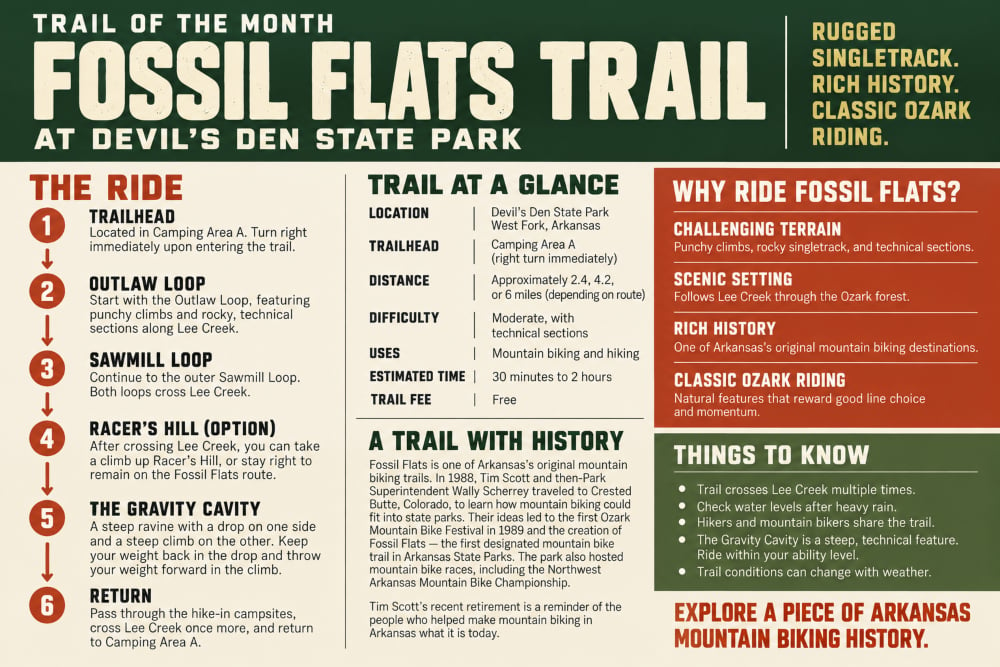
The Fossil Flats Trail begins in Camping Area A at Devil’s Den State Park. From the trailhead, riders make an immediate right turn to begin the route.
It doesn’t take long to discover the character of the trail.
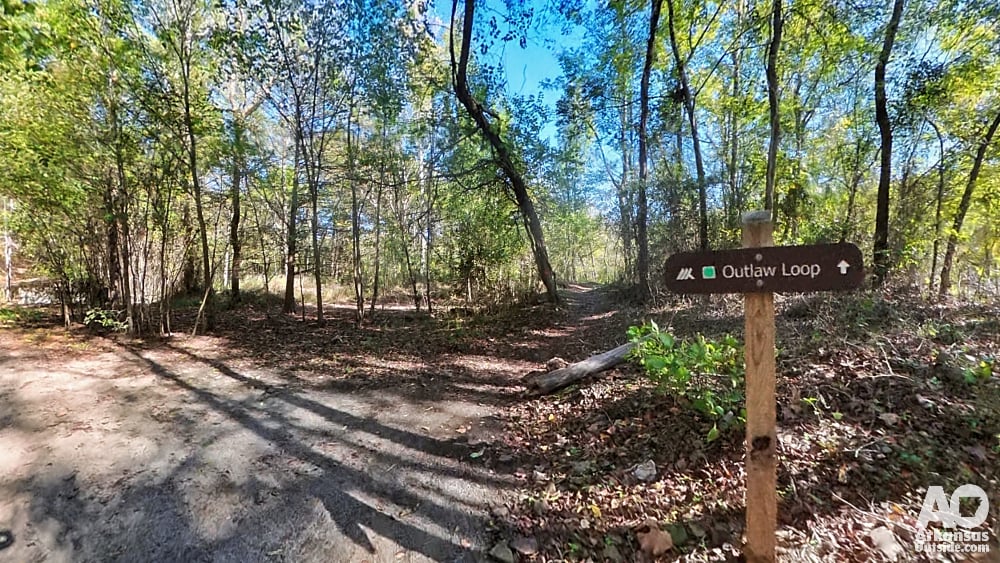
The singletrack winds through hardwood forest alongside Lee Creek, with punchy climbs and rocky, technical sections that demand attention. Rather than offering long, sustained climbs, Fossil Flats repeatedly challenges riders with short bursts of elevation and uneven terrain.
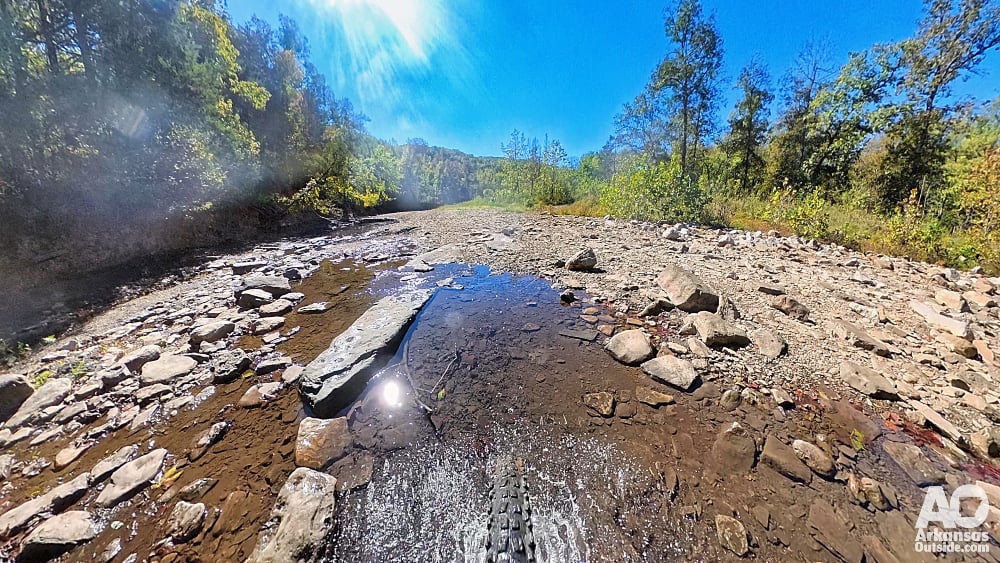
The trail consists of two connected loops, beginning with the Outlaw Loop and continuing onto the outer Sawmill Loop. Both loops cross Lee Creek, making water levels an important consideration when planning a ride.
The Outlaw Loop introduces riders to the trail’s rocky character before the route continues onto the longer Sawmill Loop.
Sawmill Loop and Racer’s Hill
After crossing Lee Creek on the Sawmill Loop, riders encounter options for additional trails, including Racer’s Hill.
The name is another reminder of the park’s competitive mountain biking heritage.
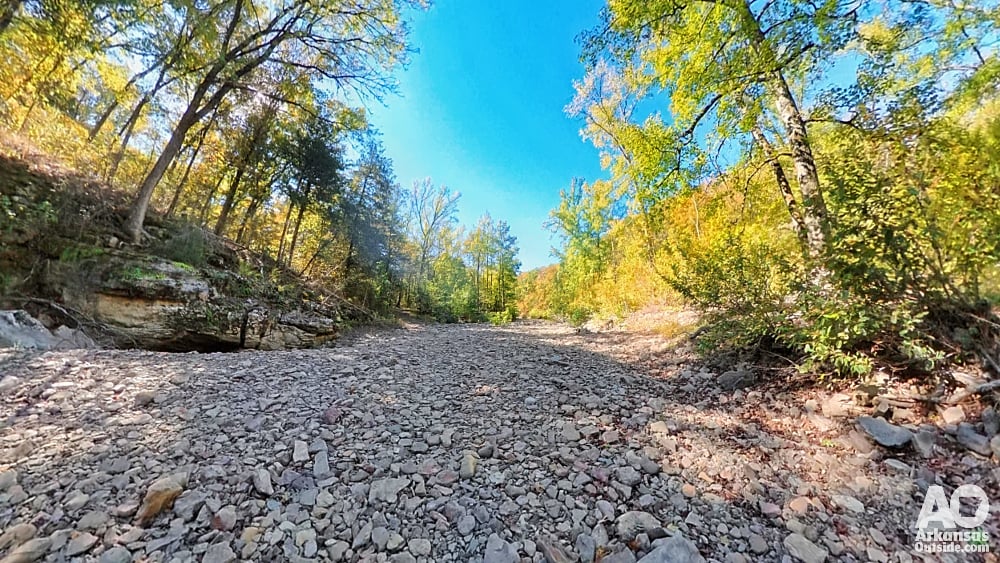
Those looking to remain on the Fossil Flats route should stay right rather than taking one of the climbing options.
The trail continues along Lee Creek, weaving through the woods and alternating between flowing stretches and technical features. It’s the kind of riding where picking the right line and maintaining momentum can make the difference between cleaning a section and putting a foot down.
The Gravity Cavity
One of the most memorable features on Fossil Flats is a steep ravine known as the Gravity Cavity.
The feature drops sharply into a drainage before immediately climbing the opposite side. It looks intimidating on approach, particularly for riders unfamiliar with the trail.
The key is momentum and body position.
On my recent ride, the technique was familiar. Shift your weight back as the bike drops into the ravine, then move your weight forward as you transition into the climb. With the right speed and timing, the bike carries through the bottom and up the opposite side.
The trick is resisting the urge to grab too much brake.
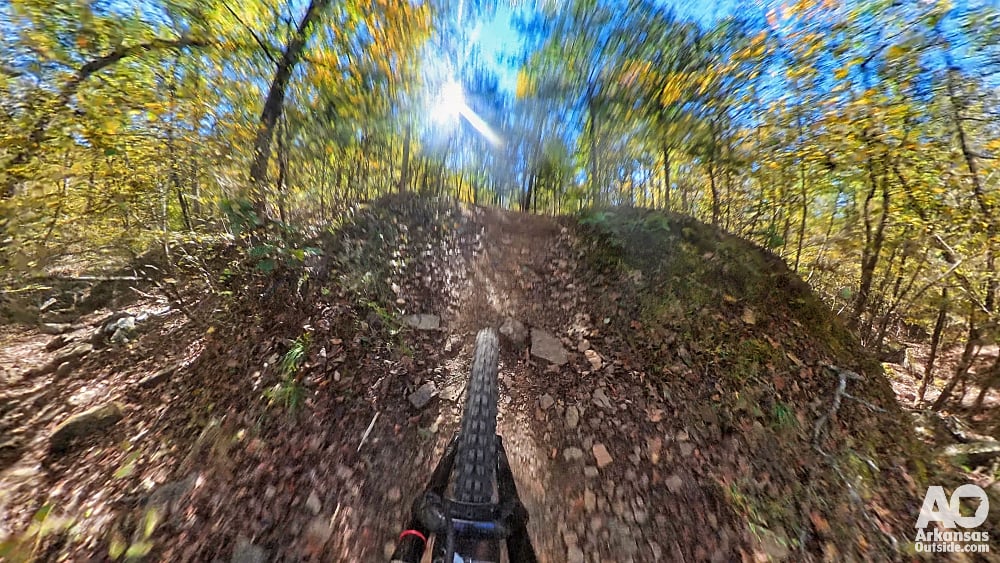
For an experienced mountain biker, the Gravity Cavity is a satisfying feature to ride cleanly. For less confident riders, there’s no shame in dismounting and walking through it. Conditions, traction, and individual skill should always determine how aggressively to approach a technical feature.
It’s also a perfect example of what makes Fossil Flats different from many contemporary trails. The challenge comes directly from the landscape rather than from constructed jumps or manufactured obstacles.
Returning Along Lee Creek
Beyond the Gravity Cavity, the route continues through the forest before passing the park’s hike-in campsites.
Another crossing of Lee Creek brings riders back toward Camping Area A, completing the Fossil Flats experience.
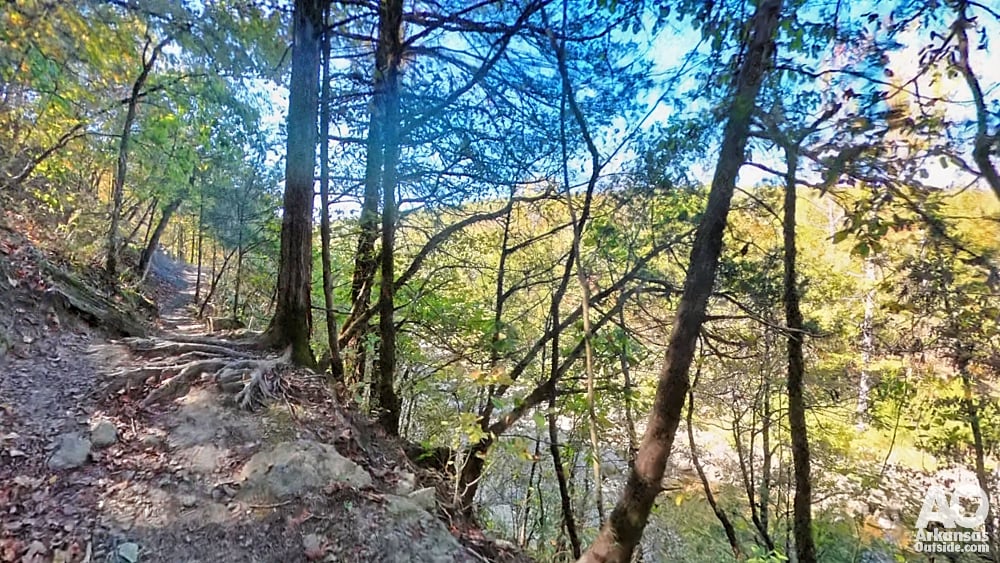
The final stretch offers a chance to appreciate the setting. Devil’s Den State Park, developed during the Civilian Conservation Corps era, is known for its sandstone formations, wooded valleys, and rugged Ozark landscape.
Fossil Flats takes full advantage of that environment, providing an intimate experience of the park that feels far removed from its roads and developed recreation areas.
From Hand-Built Singletrack to Monument Trails
Fossil Flats has changed over the decades, but its history remains an important part of the experience.
In 1988, Scott and then-Park Superintendent Wally Scherrey traveled to Crested Butte, Colorado, to attend Fat Tire Bike Week and learn how mountain biking could fit into state park recreation.
They returned with ideas that led to the first Ozark Mountain Bike Festival in 1989. The festival included trials, slow races, and unusual competitions such as log pulling. That same year, the Northwest Arkansas Mountain Bike Championship began a tradition that continues today.
Following those early successes, Scott spent months hand-building the original approximately three-mile Fossil Flats loop. It debuted around the 1990 festival and became the first designated mountain bike trail in Arkansas State Parks.
The trail has since been incorporated into Devil’s Den’s Monument Trails network, with improvements and additional routes that give riders more choices while retaining much of the area’s technical character.
For those interested in the racing history, the Northwest Arkansas Mountain Bike Championship returned to Devil’s Den on September 19, 2026, marking 37 years since the original event.
Hikers and mountain bikers share the trail, so riders should watch for people traveling in either direction. Creek crossings may become difficult or unsafe following heavy rain. Check conditions before heading out, and avoid crossing high or swift-moving water.
The Gravity Cavity and other rocky features can also change with erosion and weather. Riders unfamiliar with the trail should scout difficult sections before committing to them.
Why Fossil Flats Still Matters
Arkansas mountain biking has come a long way since Tim Scott and Wally Scherrey traveled to Colorado looking for ideas nearly four decades ago.
Today, Arkansas offers everything from beginner-friendly greenways to professionally built downhill trails and extensive backcountry singletrack. But there’s something special about returning to a trail that helped start it all.
Fossil Flats isn’t particularly long, and it doesn’t need to be. It packs plenty of riding into a relatively small area, with enough technical challenges to keep experienced mountain bikers entertained and enough history to make every mile meaningful.
Riding it during Tim Scott’s retirement celebration brought that history into focus. The trail is more than another place to ride. It’s a reminder of what can happen when people working in public recreation recognize an opportunity, embrace a new activity, and put in the work to make it happen.
Nearly four decades after those first mountain bike events at Devil’s Den, Fossil Flats continues to do what it was built to do.
Get people outside, challenge them a little, and send them home wanting to ride again.
For more on Scott’s contributions to the sport, read our recent article, Tim Scott and the Roots of Mountain Biking in Arkansas.
This article was originally published on ArkansasOutside.com, your trusted source for outdoor news and updates in The Natural State. Unless otherwise credited, all photos included in this piece are the property of Arkansas Outside, LLC. We take pride in sharing the beauty and adventures of Arkansas through our lens, thank you for supporting our work!