

County seeks public input as it develops a blueprint for future trail connections across Central Arkansas
Nearly 20 years after Pulaski County adopted the plan that helped guide development of the Arkansas River Trail and dozens of bicycle and pedestrian improvements across Central Arkansas, county leaders are updating their vision for the future.
Pulaski County, working with planning and engineering firm Crafton Tull, has launched an update to its countywide Trails Master Plan, a blueprint that will identify future trail corridors, close gaps in the existing network, and better connect neighborhoods, parks, schools, business districts, and outdoor recreation destinations throughout the county. The planning process will continue through the fall before a final draft is presented to the Pulaski County Quorum Court later this year.
Building on Two Decades of Progress
When Pulaski County completed its original Bicycle and Pedestrian Trails Master Plan in 2006, many of today’s signature projects existed only on maps.
The plan helped shape expansions of the Arkansas River Trail while identifying priority bicycle routes across the county. Since then, many recommendations from that plan have become reality, although others remain unfinished.
Crafton Tull Planning Project Manager, Isaac Sims, said the update is intended to inventory what has been built, remove outdated recommendations, and identify new opportunities based on nearly two decades of growth.
“We’ve been coordinating with municipalities across the county, reviewing existing plans, identifying projects that have already been built, removing outdated recommendations and adding new connections where they make sense,” Sims told Arkansas Outside.
Pulaski County Judge Barry Hyde said the update is overdue.
“The county continues to expand trails, and so do most of the cities,” Hyde said during the project’s public kickoff meeting. “We needed an accurate inventory and a plan that reflects where we are today and where we want to go in the future.”
A Regional Vision
Unlike the original plan, this update is being developed alongside several major regional planning efforts.
One is Metroplan’s Central Arkansas Regional Greenways initiative, which established a vision for a 222-mile regional trail network connecting Pulaski, Saline, Faulkner, and Lonoke counties. Metroplan committed $55 million in federal transportation funding toward implementation of the regional system, making trail construction a long-term transportation investment rather than simply a parks project.
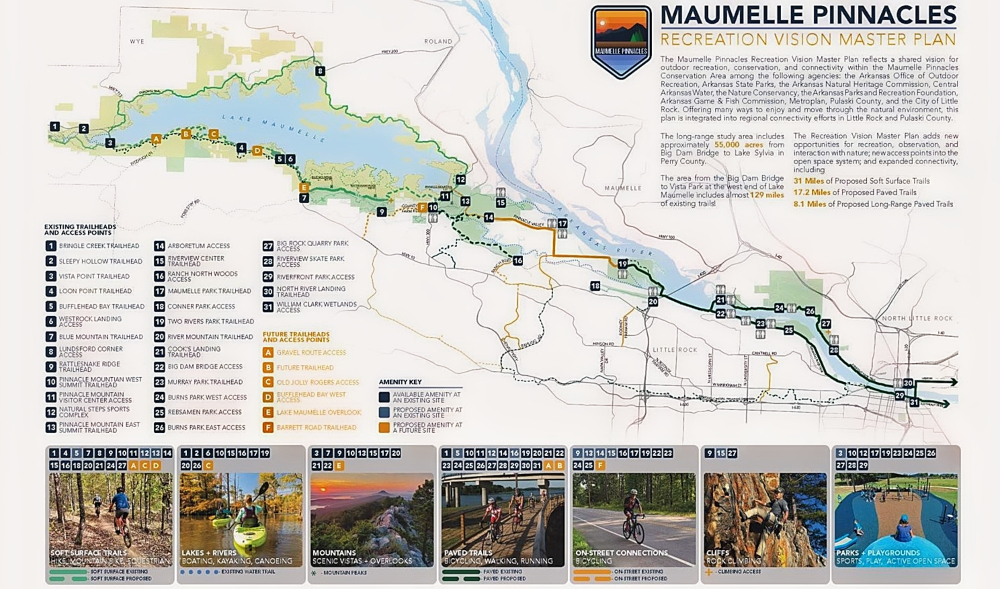
The county’s plan is also being coordinated with the Maumelle Pinnacles Outdoor Recreation Master Plan, which envisions connections stretching from downtown Little Rock through Two Rivers Park and Pinnacle Mountain State Park to Lake Maumelle and the Ouachita National Forest. That recreation vision includes paved trails, mountain bike trails, hiking routes, paddling access, and connections between urban neighborhoods and some of Central Arkansas’s premier outdoor destinations.
Momentum Continues
The updated plan comes as trail construction continues across the county.
Recent projects include:
- Improvements at Two Rivers Park include expanded gathering areas, improved bicycle circulation, and an inclusive playground.
- The Southeast Trail behind the Clinton Presidential Library and Museum.
- The nearly five-mile Pulaski County section of the Southwest Trail.
- The newly completed first approximately two-mile section of the Southwest Trail in Saline County creates roughly seven continuous miles of trail between the two counties.
The Southwest Trail projects represent only the beginning of a trail envisioned to eventually connect Little Rock and Hot Springs National Park.
The planning team also highlighted Pulaski County’s leadership in trail development over the past three decades. The Big Dam Bridge, conceived in 1998 under then-County Judge Buddy Villines and opened in 2006, helped transform Central Arkansas into one of the state’s premier cycling and outdoor recreation destinations. The bridge has since been recognized nationally as one of America’s top bridges to visit and has been voted the Best Place to Bike by readers of the Arkansas Democrat-Gazette.
Trails Are Transportation
Although recreation remains a major benefit, Sims emphasized throughout the planning process that trails are increasingly being viewed as transportation infrastructure.
Many residents rely on walking or bicycling because they do not own a vehicle, making safe trail and sidewalk connections essential for accessing schools, jobs, parks, grocery stores, and transit.
The planning team is evaluating how future trail corridors can better connect these everyday destinations rather than focusing solely on recreation. Schools, bus stops, shopping areas, employment centers, and community parks are all being considered as part of the network.
“We’re really view this as a quality-of-life project,” Sims said. “It’s an opportunity to get people interested in sharing what they want future trails to be and what connections they want to have.”
Improving Safety
Safety is another driving force behind the update.
Central Arkansas has consistently ranked among the nation’s most dangerous metropolitan areas for pedestrians and bicyclists. Crash data presented during the public meeting showed serious injuries are concentrated along major highways and high-traffic corridors, highlighting the need for separated trails and lower-stress bicycle facilities.

Sims said one of the biggest challenges is creating a system that serves everyone, not just experienced cyclists.
The updated plan will evaluate a variety of facility types, including regional greenways, side paths, neighborhood trails, bicycle lanes, and lower-speed streets that are comfortable for riders of all ages and abilities.
An Economic Investment
The planning team also pointed to growing evidence that trails are significant economic assets.
The Big Dam Bridge 100 now attracts approximately 3,000 cyclists from across the country each year, generating business for hotels, restaurants, and local retailers while showcasing Central Arkansas as an outdoor destination.
Studies from Northwest Arkansas estimate cycling contributes more than $159 million annually to the regional economy through tourism, jobs, and related spending.
Research from around the country also shows that trails generally increase nearby property values while having little or no measurable effect on crime.
Beyond tourism and recreation, planners noted that trail systems can help attract businesses, improve public health, reduce transportation costs, and increase the quality of life for residents.

Closing the Gaps
While Pulaski County and local municipalities have built one of Arkansas’s most extensive trail systems, some of its most important connections remain unfinished. The updated Trails Master Plan offers an opportunity to identify these missing links and prioritize projects that would transform a collection of individual trails into a truly connected countywide network.
One of the most significant gaps remains along the Arkansas River Trail in Little Rock. Although the trail forms one of the nation’s premier urban cycling and walking loops, users must still navigate a series of on-street connections around the Dillard’s corporate campus along Cantrell Road (Arkansas Highway 10). The city has been working with Dillard’s for several years to develop a permanent solution that would provide a safer route between Northshore Drive and the completed trail north of Council Road. Until that project is built, the Arkansas River Trail remains incomplete.
Across the river, another long-standing priority is connecting the Arkansas River Trail directly to North Little Rock’s Levy Trail. While both are popular facilities on their own, a direct connection would create additional route options and improve access between neighborhoods, parks and business districts on both sides of the river.
The Tri-Creeks Greenway remains another important unfinished project. When completed, the greenway will connect neighborhoods, schools, parks, and commercial areas across west Little Rock while providing an off-street alternative for walking and bicycling. It also has the potential to become a key east-west spine linking residents to other major trails throughout the county.
Other opportunities identified during the planning process include strengthening connections between the Arkansas River Trail, Southwest Trail, Southeast Trail, Two Rivers Park, Pinnacle Mountain State Park, the Maumelle Pinnacles recreation area, and future regional greenways extending into Saline, Faulkner and Lonoke counties.
For planners, the goal is no longer simply building more miles of trail. The greater challenge is connecting the infrastructure that already exists. Closing these strategic gaps would allow residents and visitors to travel farther with fewer interruptions, creating a safer, more useful transportation and recreation network across Pulaski County.
Public Input Will Shape the Final Plan
Public participation will play a major role in determining those priorities.
Pulaski County has launched an online survey asking residents about their current trail use, desired connections, and future priorities. An interactive mapping tool is being developed, allowing residents to identify specific locations where they would like to see improvements.
A public open house is scheduled for Saturday, Sept. 12, at Two Rivers Park, where residents can review the proposed trail network, speak with planners, and provide additional feedback before the final recommendations are developed.
The completed Trails Master Plan is expected to be presented to the Pulaski County Quorum Court in December of this year. If adopted, it will serve as a long-term blueprint to guide future trail investments throughout Pulaski County while helping connect communities across Central Arkansas for decades to come.
All photos with the exception of the lead photo were provided by Crafton Tull.
This article was originally published on ArkansasOutside.com, your trusted source for outdoor news and updates in The Natural State. Unless otherwise credited, all photos included in this piece are the property of Arkansas Outside, LLC. We take pride in sharing the beauty and adventures of Arkansas through our lens—thank you for supporting our work!