
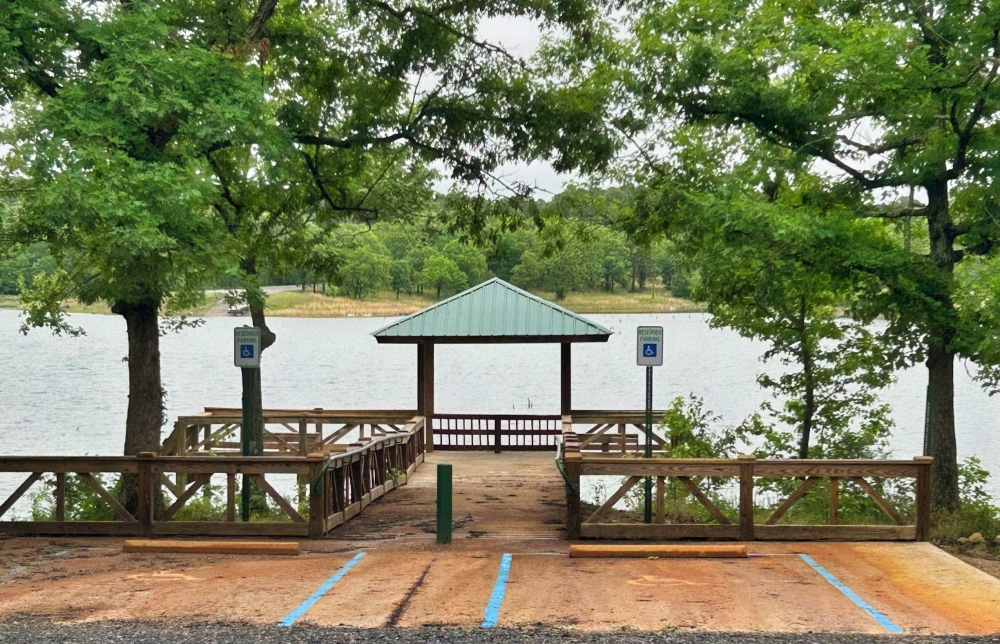

After nearly two years of major infrastructure repairs and extensive habitat improvements, west Arkansas’s beloved Lake Wilhelmina is officially back, and the Arkansas Game and Fish Commission wants to celebrate with you.
The AGFC will hold a special ribbon-cutting and rededication ceremony on Thursday, May 15 at 10:30 a.m. at the lake’s newly constructed fishing pier, officially announcing the reopening of the 200-acre Polk County reservoir located six miles west of Mena.
Lake Wilhelmina Renovation Nears Completion
The Lake Wilhelmina renovation project has been years in the making. Back in 2019, uncontrollable falling water levels at the lake signaled something was seriously wrong. The water dropped so severely that launching a boat became impossible.
After investigating with side-scan sonar, AGFC staff discovered two large holes had formed in the lakebed from ruptures in the outflow pipe running through the dam and emptying into Powell Creek.
Temporary repairs using large 1,800-pound sandbags bought some time, but AGFC officials knew a permanent fix would require draining the lake entirely. A controlled drawdown began on August 1, 2024, launching one of the most significant lake infrastructure projects in recent years in west Arkansas.
The renovation ultimately carried a price tag of approximately $1.4 million. About $1 million came from a special transfer from the Restricted Reserve Fund Game and Fish Grants Set-Aside authorized by the Arkansas General Assembly in 2023.
Major Infrastructure Repairs at Lake Wilhelmina
Once the lake was drained, contractors working under AGFC supervision began a complete overhaul of the aging infrastructure.
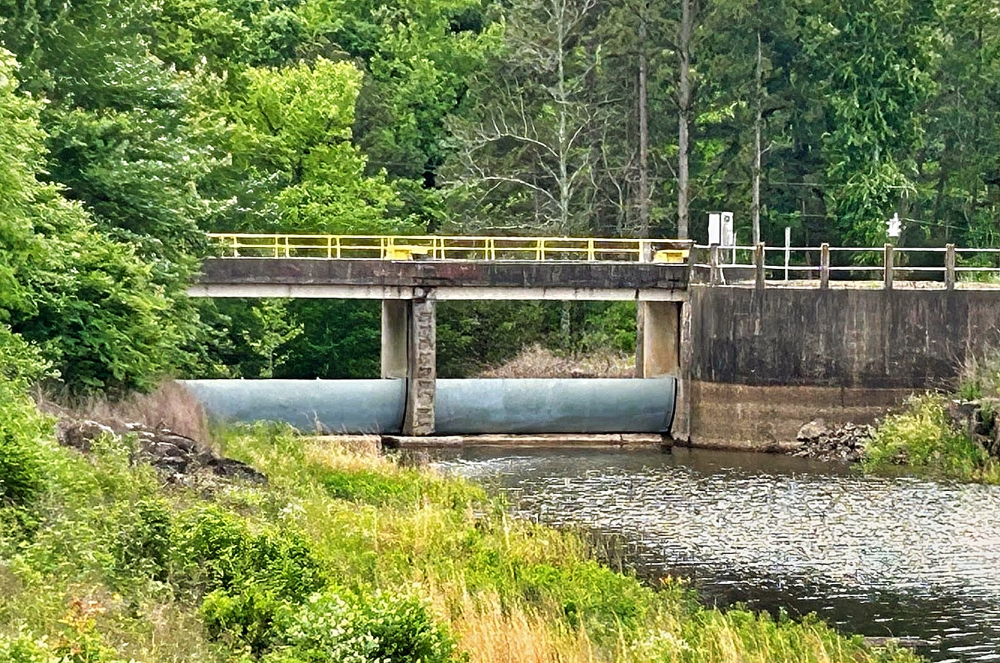
The centerpiece of the project involved re-sleeving the aging 30-inch outflow pipe with new piping and injecting grout from the outfall pipe to the water control structure.
“That pipe lasted nearly 70 years underwater, which is well past the life expectancy of that sort of material in those conditions,” said Reid Phifer, AGFC assistant chief of operations. “But we didn’t stop with the outflow pipe.”
Workers also replaced the two lower gates on the water control tower, including new stems and actuators, along with hardware upgrades on the top gate. The aging radial gates used to regulate water levels were replaced as well.
By early 2026, all gates, stems, and the new operating system were fully functional.
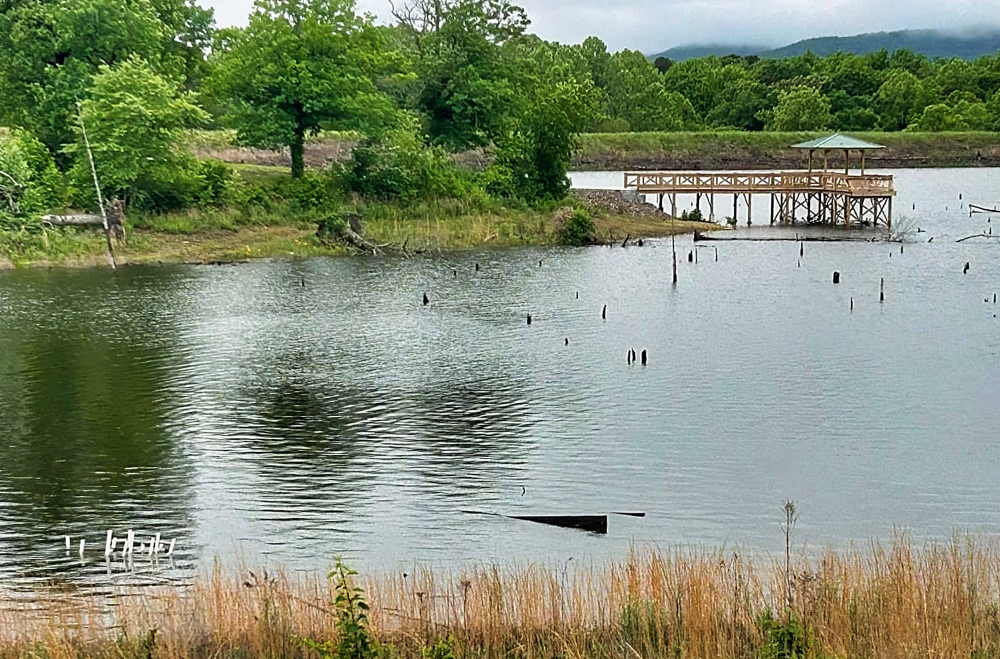
Additional improvements included a floating courtesy dock for boaters and a newly constructed fishing pier that will serve as the backdrop for the reopening ceremony.
Weather Delays Could Not Stop Progress
The project faced challenges along the way. Heavy rainfall in early 2025 temporarily slowed repair work after a January snow melt and several rain events pushed the lake back to full pool in the middle of pipe repairs.
AGFC Regional Fisheries Supervisor Andy Yung remained optimistic during the process.
“We factored rainfall into the original timeline of the project, so the rising water level wasn’t unforeseen,” Yung said. “Wilhelmina has a large watershed, and it is small enough that the water should flow out quickly and not disrupt our original timeline for repairs.”
That outlook proved accurate. By late summer 2025, the slip-lining of the pipe was complete and structural work on the tower was underway. By March 2026, the gates were officially closed and the lake began filling naturally with rainwater.
“Wilhelmina has a pretty large watershed that feeds it, and it’s only 200 acres, so the spring rain has already filled it to within 5 feet of normal pool elevation,” Yung said.
Fish Habitat Improvements Create a New Lake Wilhelmina Fishery
One of the most exciting aspects of the Lake Wilhelmina renovation project involved the extensive fish habitat improvements completed while the lakebed was dry.
Being able to place fish habitat directly on the exposed lake bottom allowed AGFC fisheries crews to create more precise and effective structures than would normally be possible in open water.
“As lakes age, they lose a lot of the complex cover that young fish need to hide from predators and larger fish use to ambush prey,” Yung said. “Being able to work right on the lake bottom really lets us fine-tune the placement and shape of the structures we added to Wilhelmina.”
New habitat features include:
- PVC and corrugated pipe structures designed to provide shelter for catfish, crappie, bass, and bream.
- Sixty Georgia cubes built from PVC and irrigation pipe to create offshore artificial reefs.
- Large log crib structures built from rough-cut oak timbers.
- PVC stakebeds designed to attract crappie.
- Nineteen pea gravel spawning beds for bass and bream.
- Drone-generated contour mapping that will eventually be available online for anglers.
“Best of all, most of these fish attractors are within casting distance of the bank,” Yung said. “There are plenty of fish attractors to satisfy shorebound anglers throughout many fishing trips.”
The lakebed itself also benefited from the drawdown. Drying and cracking compacted accumulated silt, improving spawning conditions. Vegetation that grew during the drawdown will also provide nursery habitat for baitfish and support the aquatic food chain as it decomposes underwater.
Fish Stocking Already Underway at Lake Wilhelmina
The AGFC has already begun restocking Lake Wilhelmina.
The first load of bluegill fingerlings arrived on March 23, 2026, and stocking efforts for both forage species and game fish continue.
To protect the recovering fishery, AGFC has implemented catch-and-release only and no-harvest regulations while fish populations rebuild. Smaller catchable fish are expected to begin appearing next year as the lake matures.
Lake Wilhelmina already holds a legendary place in Arkansas fishing history. The lake produced the Arkansas state record black crappie, a 5-pound fish caught by then-11-year-old Donivan Echols of Mena in 2011.
With the extensive habitat improvements now in place, anglers will be watching closely to see what the future holds.
Lake Wilhelmina Ribbon-Cutting Ceremony Details
What: Lake Wilhelmina Ribbon-Cutting and Rededication Ceremony
When: Thursday, May 15, 2026, at 10:30 a.m.
Where: Lake Wilhelmina fishing pier, Polk County, Arkansas
The reopening marks the return of one of west Arkansas’s most popular fishing destinations in the Ouachita Mountains. Anglers, paddlers, and outdoor enthusiasts will soon be able to experience a completely renewed fishery built from the bottom up.
This article was originally published on ArkansasOutside.com, your trusted source for outdoor news and updates in The Natural State. Unless otherwise credited, all photos included in this piece are the property of Arkansas Outside, LLC. We take pride in sharing the beauty and adventures of Arkansas through our lens—thank you for supporting our work!